
B2B Buying & Sourcing Guides
How to Source Your First Wooden Kitchen Utensil Set from China
A first-order guide for new importers and private-label brands sourcing wooden kitchen utensil sets from China: set choice, samples, finish, packaging and RFQ.
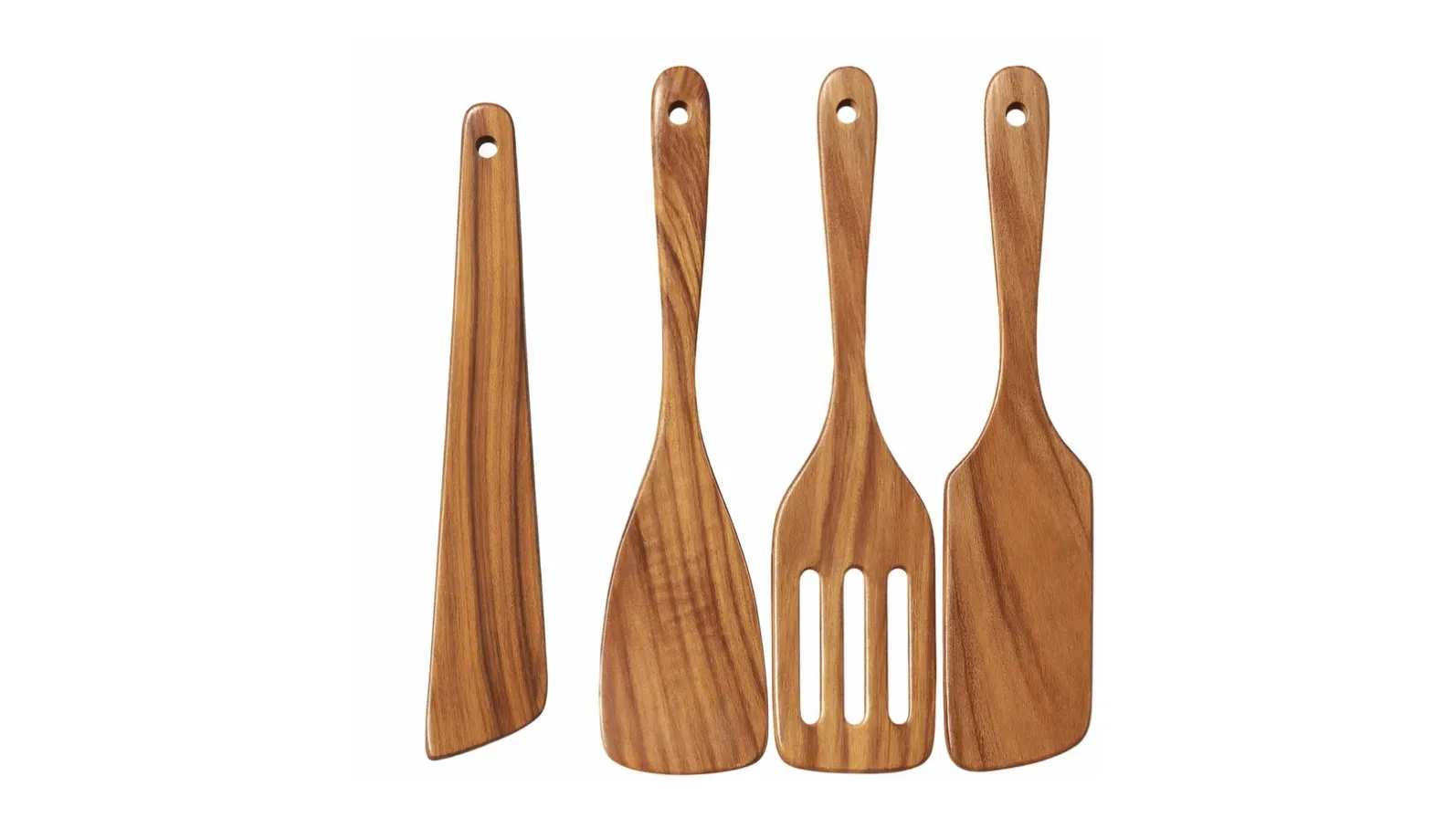
A first wooden kitchen utensil order from China is easier to manage when you choose one clear set format, confirm what is included in the piece count, and approve a physical sample for shape, surface, finish and packaging before bulk production. Rewood Houseware manufactures and supplies teak wooden utensil sets for importers, new private-label kitchen brands and other B2B buyers who need a practical first SKU rather than a large, undefined assortment.
This guide is for first-time importers and new brands. It is not a consumer lifestyle article, and it is not a substitute for a product specification or a market-specific compliance review.
Quick Answer: What Should You Confirm Before a First Wooden Utensil Order?
For a workable first order, confirm these points before you ask for a firm bulk quotation:
- Set format: a focused 4-piece spatula set, a coordinated 9-piece cooking-utensil set, or a single tool
- Exact piece list: which tools are included, and whether a holder, spoon rest or hooks are part of the count
- Material and surface: wood species, appearance range, and the finish to be approved on the sample
- Logo method and position, if you want branding on the utensils or only on the packaging
- Packaging type for your sales channel, plus labels and care cards
- Target market, because food-contact and wood-documentation needs are project-specific
- Estimated quantity, including whether you are starting at a standard set MOQ
- Sample approval before bulk production
Unit price alone is not enough. For wooden utensils, set completeness, edge finishing, surface consistency and packaging protection often decide whether the first order can be repeated.
1. Start With One Set Format, Not a Long Wish List
A first order is usually stronger when it is built around one retail SKU that you can sample, pack and inspect clearly. Adding too many shapes, sizes or accessory options at the start makes quotation, sampling and quality control harder than they need to be.
A Focused 4-Piece Spatula Set
Rewood’s custom 4-piece teak wooden spatula set is a practical starting format for buyers who want a smaller kitchen-tool assortment. The current standard set includes a paddle, turner, slotted spurtle and wood scraper. The written product specification gives an approximate maximum size of 12 L × 3 W in / 30.5 × 7.6 cm, with individual sizes varying by tool shape. The utensils use one-piece wooden construction with long handles and a smooth polished natural wood finish.
This format is often easier for a first order because there are fewer shapes to approve, a smaller packaging footprint, and a simpler story for wholesale, retail or a first private-label listing.
A Coordinated 9-Piece Utensil Set
Rewood’s custom 9-piece teak wooden utensil set is designed as one coordinated cooking-tool SKU for everyday stirring, flipping, mixing and serving. The standard product is a nine-piece wooden cooking utensil set, but the final utensil combination should be confirmed against the approved project specification. Custom combinations can be reviewed for OEM or ODM feasibility.
The usual MOQ for this set is 500 sets. Special customization or packaging may have a separate minimum, so confirm both the product MOQ and any packaging minimum before you treat a quotation as complete.
A Single Wooden Tool
Some buyers start with one utensil, such as a meat chopper or ground-beef masher, and add a set later. A single tool can be simpler to specify, but it may also be harder to present as a complete first retail offer. If you choose this route, still confirm function, dimensions, finish, logo, packaging and care instructions on the sample. Rewood’s current meat-chopper reference is a manual wooden kitchen tool, not a cutting knife or cleaver, with a usual MOQ of 500 pcs.
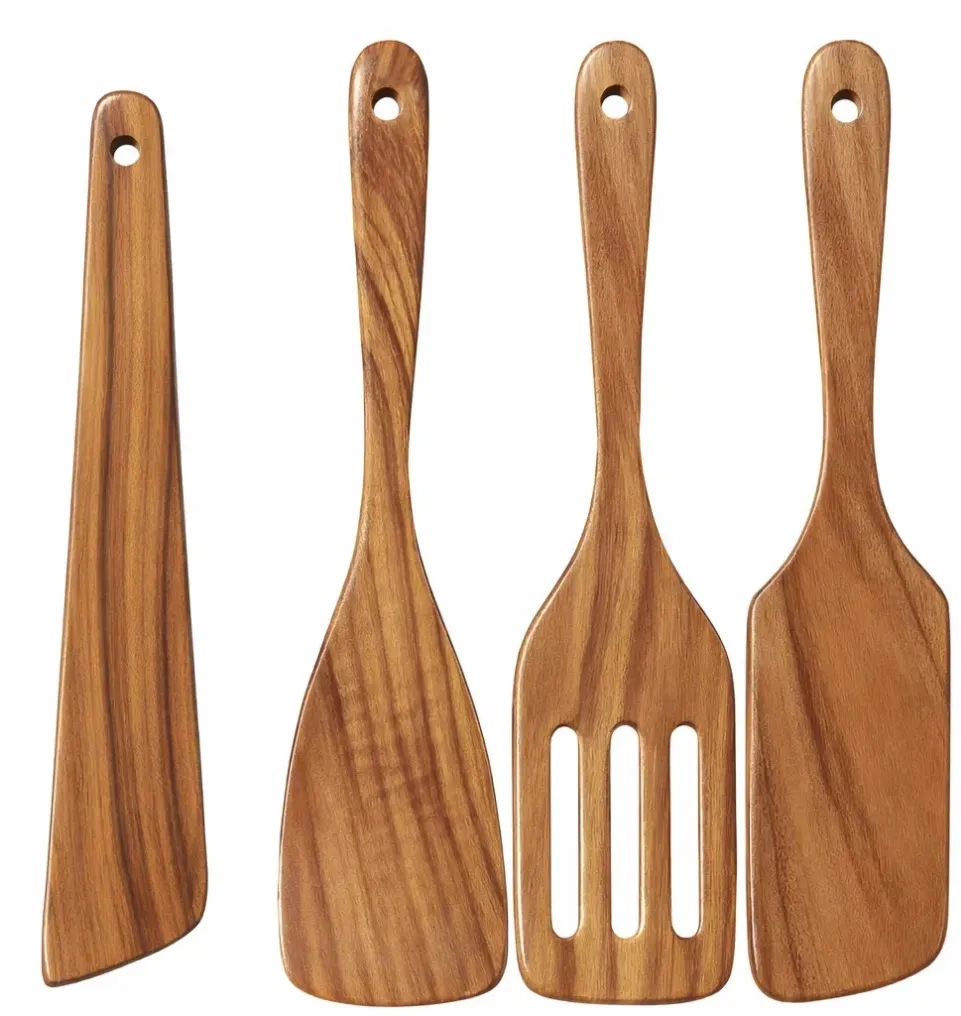
The four-piece set uses four different tool shapes. Confirm each shape, not only the set name, before sampling.
How to Choose Between These Formats
First-order situation | Format to evaluate first |
|---|---|
You want a smaller first SKU and fewer shapes to approve | 4-piece spatula set |
You want one retail set that covers several everyday cooking tasks | 9-piece utensil set, with the exact combination confirmed |
You want to test one tool before building a collection | Single utensil, specified on its own |
Your packaging budget is limited | Start with a simpler pack, then upgrade artwork later |
You already have a reference photo or retail listing to match | Send the reference and ask the factory to confirm which format it actually is |
The key rule is simple: choose the set you can describe clearly in an RFQ. “Please quote wooden utensils” is not a specification.
2. Confirm What the Piece Count Actually Includes
This is one of the most common first-order mistakes.
A “9-piece set” may mean nine cooking utensils only. It may also be photographed with a holder, a spoon rest or hanging hooks. Those extra items change the bill of materials, the packaging size, the carton weight and the inspection checklist.
Before sampling, ask the supplier to write down:
- The exact tool list by shape and name
- Whether a holder, rest, hooks or other accessories are included in the set count
- Which items are optional extras
- The quantity that will be packed in each retail package
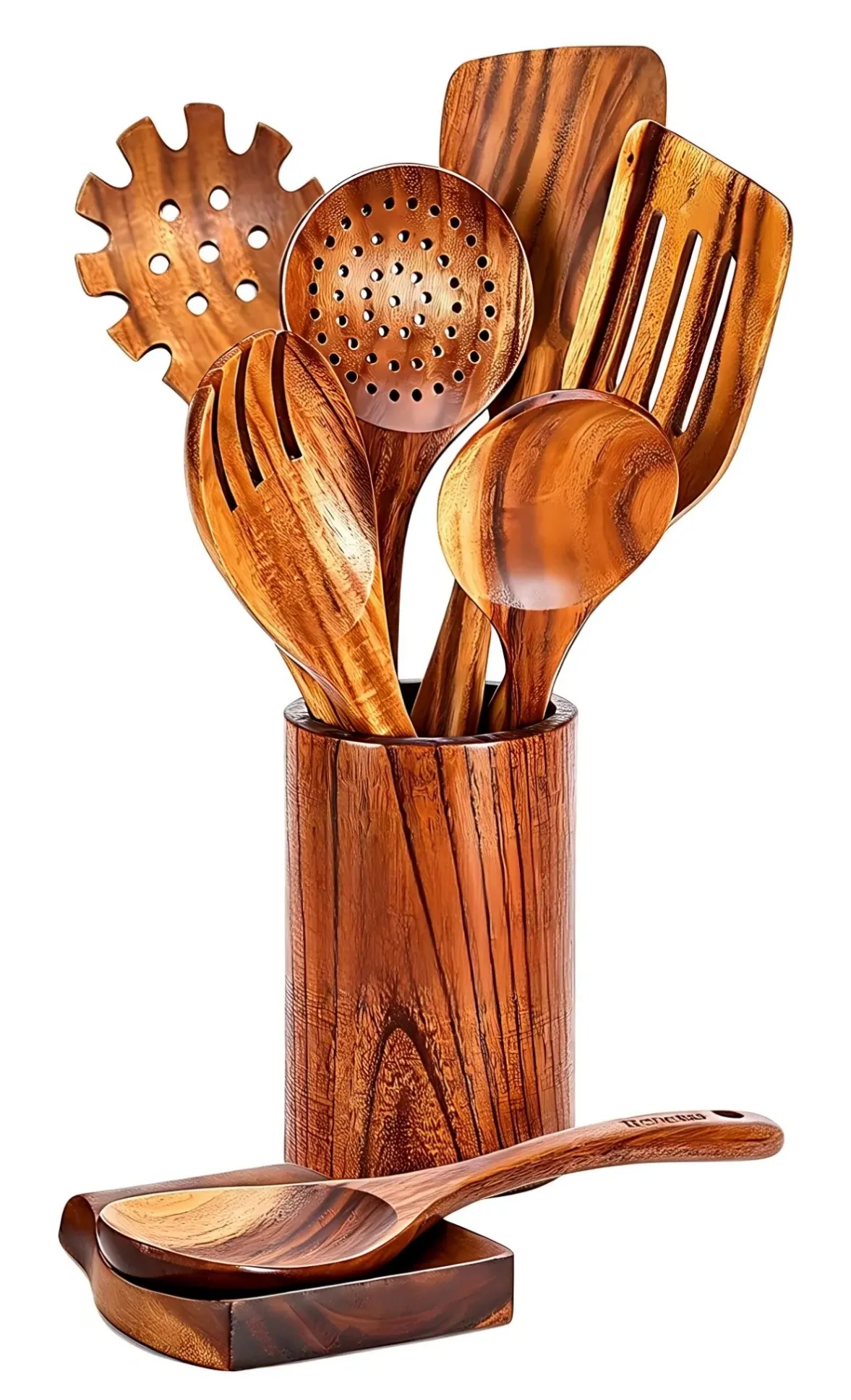
Product photography may show a holder or rest. Confirm whether those pieces are included in the set count before you approve the sample.
Do not approve a sample against a lifestyle photograph alone. Approve it against a written packing list.
3. Treat Material and Finish as Part of the Specification
Rewood’s current utensil reference products are made from teak wood. Teak grain, tone and pattern naturally vary between pieces. That variation should be treated as a natural-material characteristic and controlled by an approved appearance range, not ignored and not described as a defect when it stays within the agreed range.
For a first order, confirm:
- The wood species you are actually buying, not a generic “wooden” label
- Whether the surface is a natural polished finish or another approved finish
- Whether any additional coating will be used
- How color and grain variation will be judged in bulk
- The care instructions that will be printed for that approved finish
Do not assume that a photograph of a glossy or oil-like surface tells you the exact factory finish. The finish you approve on the sample is the finish that should be used as the bulk-production standard.
If you are comparing bamboo and wood for a wider kitchen collection, review the material differences separately. Wooden utensils and bamboo products should not be specified as if they were the same material.
4. Check the Sample Before You Lock the Bulk Order
A sample is not only a “looks fine” check. For wooden utensils, record what you have actually approved.
On the sample, check:
- Correct tool shapes and complete set count
- Handle length, head shape and overall balance for normal use
- Edge sanding and the absence of sharp splinters
- Cracks, chips, loose fibers, excessive knots or other visible surface damage
- Straightness of handles
- Smoothness of the working surface
- Hanging-hole position and finish, if holes are part of the design
- Color and grain within the range you are willing to accept
- Logo size, position and clarity, if branding is applied
- Packaging fit, inner protection and the order in which utensils are packed
- Labels, barcodes and care-card wording
The current product pages describe these utensils as suitable for use with nonstick cookware and for normal use with cast-iron and stainless-steel cookware. That is a use recommendation from the approved product specification, not a promise that every coating or cooking condition is risk-free. If nonstick use is important to your listing, state it in the RFQ and check the sample edges and surface yourself.
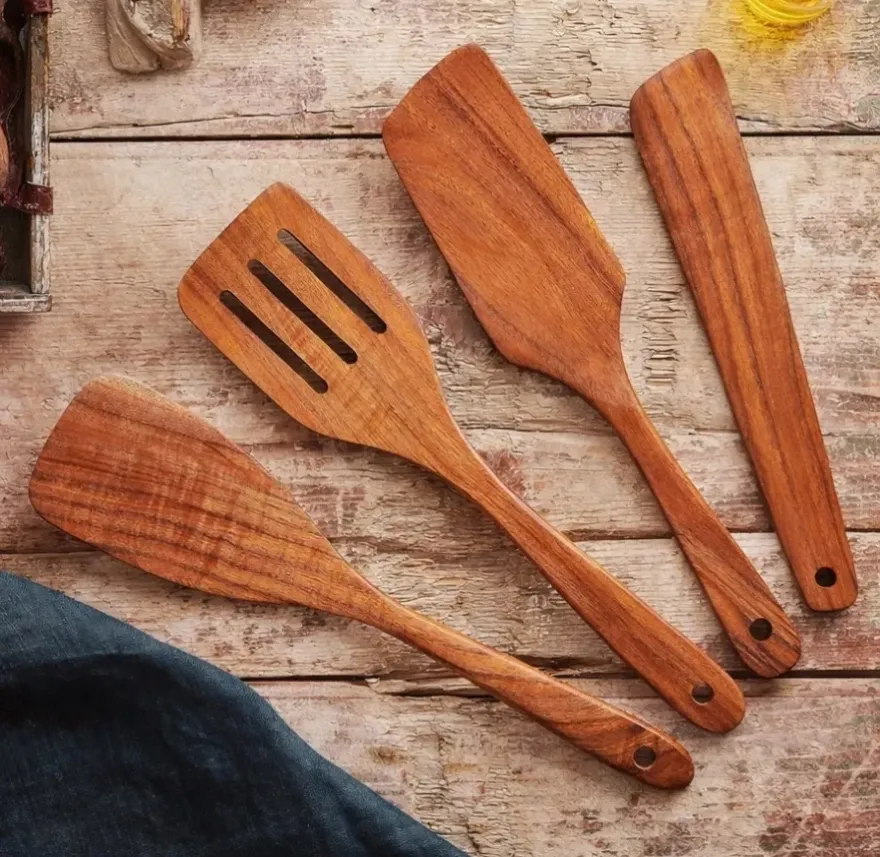
Grain and color vary between pieces. Approve an acceptable appearance range, and check edges for splinters, during sample review.
After approval, keep a signed or written sample record: set list, material, finish, logo, packaging, and any points that must be copied in bulk. Bulk production should follow that approved sample, not an earlier photo or a later verbal change.
For Rewood’s current 9-piece set and meat-chopper reference products, sample lead time is usually 7–15 days, and bulk production is usually 20–35 days after sample approval. These are typical ranges from the current product pages and should be confirmed for your quantity, logo, packaging and production schedule.
5. Choose Packaging for the First Order, Not for a Future Ideal Range
For a first wooden utensil set, packaging has two jobs: protect the tools in transit and present the set in the channel where you will actually sell it.
Common options on Rewood’s current utensil programs include a paper band, kraft box, printed kraft box, retail color box, gift box or mail-order box. A multi-piece set usually needs the utensils fixed in a consistent order so handles, heads and finished surfaces are not scuffed against each other.
For a first order, a practical sequence is:
- Confirm the exact set contents and overall packing size
- Choose a packaging level that matches your first sales channel
- Check whether printed packaging has a separate minimum quantity
- Approve artwork only after the product dimensions and packing layout are stable
- Confirm barcode, care instructions, destination-language text and export carton marks
Hand-wash care instructions are part of the product offer, not an afterthought. Current Rewood utensil care guidance is to hand wash with mild soap and warm water, dry promptly, avoid long soaking, and keep the utensils out of the dishwasher. The 9-piece page also advises against microwave use and says final care instructions should match the approved surface finish. If mineral oil is mentioned on a care card, treat that as care guidance for the approved finish, not as a substitute for confirming the factory finish itself.
6. Scope Compliance by Product and Market, Not by a Generic Claim
Wooden cooking utensils are food-contact products. The documents or tests you need depend on the actual wood, the surface finish or coating if any, the intended use and the destination market. Do not treat a general factory statement as proof that every SKU is already cleared for every market.
For a first order, tell the supplier your target market early and ask which of the following can be reviewed for that exact specification:
- Food-contact documentation or testing related to FDA, LFGB or REACH, where relevant
- FSC-certified sourcing, if you need an FSC claim on an eligible wood project
- amfori BSCI factory audit information, which relates to social-compliance auditing of the manufacturing facility and is not a product certification
- EUDR traceability and due-diligence documentation, if you are shipping applicable wood products to the EU
Rewood can review these points according to the confirmed product, material source, manufacturing arrangement, destination market and order requirements. FSC-certified sourcing applies to eligible wood projects and should be confirmed before quotation if you need that claim. EUDR support, where applicable, means material-source traceability, supplier information and due-diligence documentation for the buyer’s process. It is not an “EUDR certificate.”
This matters more for wooden utensils than many first-time buyers expect. Products made solely from bamboo are currently treated differently from wood under EUDR, but teak utensils are wood products. If your first collection mixes bamboo items and wooden utensils, do not assume one documentation package covers both. For the legal framework and current timing, read Rewood’s guide Is Bamboo Covered by EUDR?. For the difference between frameworks, test reports and certificates, use the FDA, LFGB, REACH & FSC guide for bamboo and wooden kitchenware. Neither article is legal advice; final requirements depend on your product and market.
7. Put a Complete First RFQ on Paper
A useful first RFQ for a wooden utensil set usually includes:
- The set format you want, or a clear reference photo
- The exact utensil list, including accessories
- Target quantity for the first order and, if known, a later repeat quantity
- Preferred wood species and finish direction
- Logo file and preferred position, or a note that branding will be on the packaging only
- Packaging type, label needs and care-card language
- Sales channel, such as wholesale, retail, an independent website or another program
- Target market and any food-contact, FSC or EUDR documentation you already know you need
- Trade term and delivery destination, if you have them
If you want a broader template for custom bamboo and wood houseware inquiries, follow How to Request a Quote for Custom Bamboo & Wood Houseware. Use that checklist, but still write the utensil-set details above in the same message.
Ready to Specify Your First Wooden Utensil Set?
If you are planning a first wooden kitchen utensil order, contact Rewood Houseware with your set format or reference photo, exact piece list, estimated quantity, logo and packaging needs, target market and delivery destination. The team can review a practical sample and quotation path for a 4-piece spatula set, a 9-piece utensil set or a related wooden kitchen-tool project.
Send the set list, target market and packaging direction first. That gives you a quotation and sample plan you can actually approve.
Frequently Asked Questions
What is a practical first wooden utensil set for a new importer?
A focused 4-piece spatula set is often the simplest first SKU because it has fewer shapes to approve and a smaller packaging footprint. A coordinated 9-piece set can work if you need one retail SKU that covers more cooking tasks, but you should confirm the exact combination first.
Do I need a custom design for the first order?
No. Many first orders start from a current reference set, then add a logo, labels and packaging. Custom shapes, handle lengths or tool combinations can be reviewed after the basic format is clear, and they may change the sample path, timing or minimum quantity.
What is the usual MOQ?
For Rewood’s current 9-piece teak utensil set, the usual MOQ is 500 sets, and special customization or packaging may have a separate minimum. The 4-piece spatula set page asks buyers to confirm MOQ according to quantity, logo and packaging. Final minimums should be confirmed in the quotation for your project.
How long do samples and bulk production usually take?
On Rewood’s current 9-piece utensil and meat-chopper reference pages, sample lead time is usually 7–15 days, and bulk production is usually 20–35 days after sample approval. Confirm the timing for your quantity, logo, packaging and production schedule.
Are wooden utensils automatically food-safe or certified?
No. Food-contact requirements depend on the actual material, finish or coating, intended use and destination market. Ask for project-specific review rather than a general claim that every wooden utensil is already certified.
Does EUDR apply to wooden utensil sets?
Teak and other wood utensils may fall under a different analysis from products made solely from bamboo. If you sell into the EU, ask for the documentation path that applies to the confirmed wood product. Do not assume a bamboo-only explanation covers a wooden utensil set.
Can I add my logo on the first order?
Yes. Current Rewood utensil programs can review laser engraving, printing or packaging branding. Approve the logo position and method on the sample, and remember that any Rewood mark shown in product images is for branding reference only.
About the Author
Written by Jessie Jiang
Overseas Business Development, Rewood Houseware
Jessie works with importers, distributors, wholesalers, retailers and private-label brands on bamboo and wood houseware manufacturing, product development, packaging coordination and export projects.
Reviewed by the Rewood Product Development & Quality Control Team
This article is based on Rewood’s current wooden utensil product specifications and on practical experience supporting sampling, private-label packaging and export coordination for kitchenware programs.
Last updated: November 11, 2026