ODM Product Development for Bamboo & Wood Houseware: From Concept to Mass Production
ODM product development for bamboo & wood houseware in eight steps, from concept to mass production — samples in 7–15 days, production in 20–35 days, MOQ 500 pcs.
Quick Answer
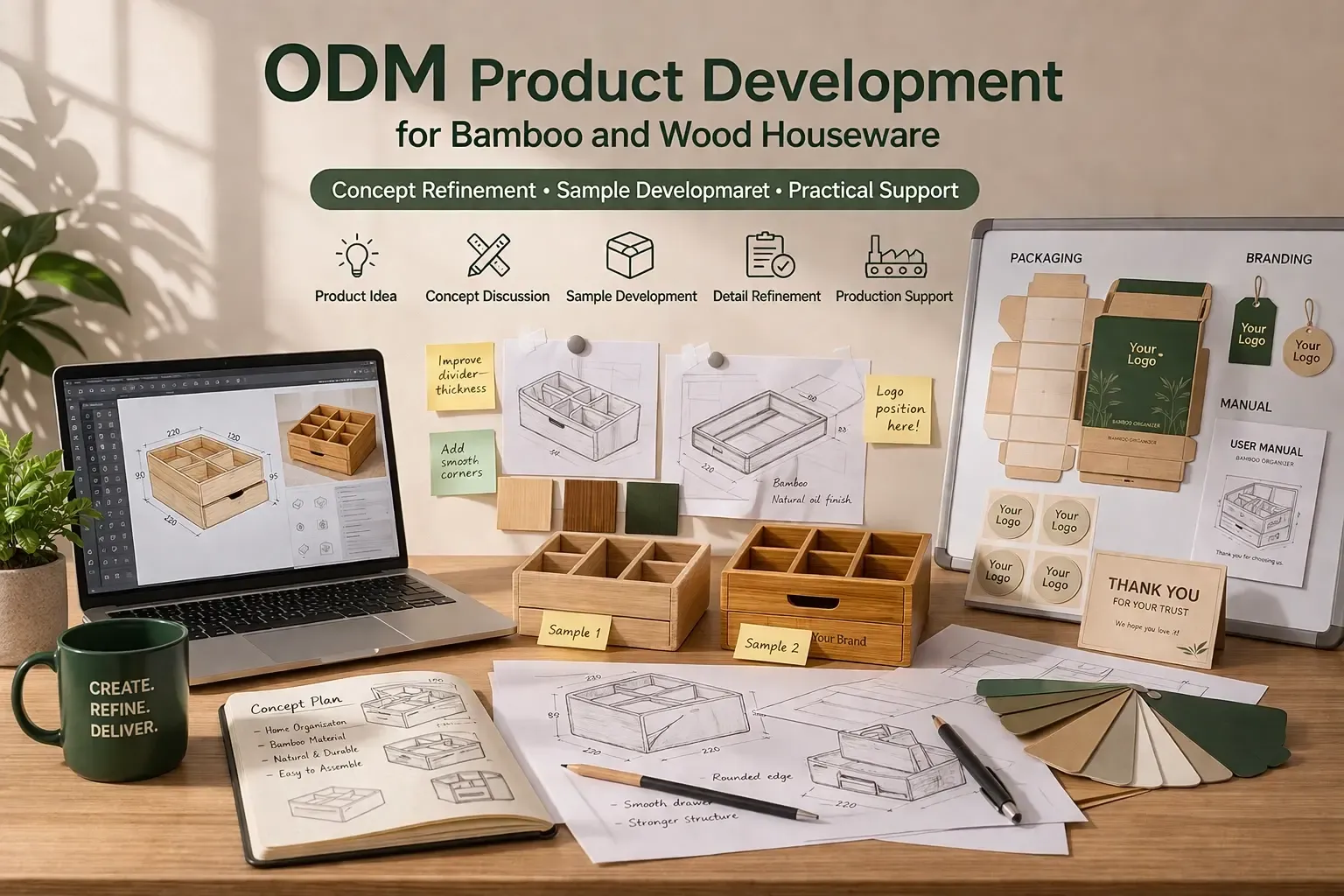
ODM product development takes your idea from concept to mass production in eight steps: concept and requirements, material and structure feasibility, technical drawings and dimensions, prototyping and sampling, sample testing and buyer confirmation, packaging and branding confirmation, mass production with in-process quality control, and final inspection and shipment. Samples are normally ready in 7–15 days (for samples based on existing structures; a fully new structure is confirmed per project), mass production takes 20–35 days after sample confirmation, and the standard minimum order quantity is 500 pcs per product. Final inspection follows ISO 2859-1 Level II sampling, with zero tolerance for critical defects. Development time and any development costs are confirmed per project based on complexity — there is no standard fee, because no two products are the same.
This guide walks through each step: what happens, what you provide, and what Rewood delivers. If you are still deciding whether ODM is the right route, read how OEM and ODM compare for bamboo & wood houseware first.
Step 1: Concept & Requirements
What happens: you tell us what you want to make, and we turn it into a written brief that development can work from — the product's purpose, who will use it, the size and shape you have in mind, the target price, and the market it is for. We ask questions where the idea is still open: a vague brief is the most common cause of slow development, because every unanswered question becomes a sample round later.
What you provide: a description of the product and its use, reference products or photos, sketches if you have them, and your target size, price range, quantity and timeline. You do not need drawings at this stage; that is step 3.
What Rewood delivers: a confirmed brief, a first view on whether the product is feasible in bamboo or wood, and the questions that still need answers. If the idea cannot be made to your target price or quality, we say so here — before you spend anything on development.
Step 2: Material & Structure Feasibility
What happens: we check whether your product will work in the materials you want, and whether its structure will hold up in use. Bamboo, acacia and beech differ in hardness, grain, weight and how they take a finish. A shape that works in plastic may not work in wood, and a joint that works in a small box may fail in a large one. We also check the practical size range and whether the product needs special treatment for its intended use, such as food-contact use.
What you provide: your material preference if you have one, the product's intended use and environment, and any requirements from your market. If you are unsure about materials, see our bamboo vs acacia vs beech wood material guide.
What Rewood delivers: a material recommendation, a feasibility view on the structure, and any changes we suggest before drawings start — for example, a thicker section where strength matters. Changes made here are free; changes made after tooling are not.
Step 3: Technical Drawings & Dimensions
What happens: the approved concept becomes a technical drawing with exact dimensions, tolerances, material thickness, joint details and finish specifications. This is the document production will work from, so it has to be complete: every dimension and tolerance that matters, and the finish on every visible surface. We also confirm the logo method and position — laser engraving or printing — and the packaging dimensions, so the box fits the product rather than the other way round.
What you provide: review and approval of the drawings. Check the dimensions against your market's needs — shelf sizes, storage sizes, shipping carton sizes — and confirm anything that affects how your customer will use the product. This is the cheapest point in the whole project to make a change.
What Rewood delivers: technical drawings and a dimension list for your approval, plus confirmation of the material, finish, logo method and packaging. Nothing is sampled until you approve the drawings.
Step 4: Prototyping & Sampling
What happens: we make a prototype and then a sample, following the approved drawings. The prototype tests the structure — does it fit together, does it stand up, does it feel right in the hand — and the sample is the version made to the final specification, including finish, logo and packaging. Samples based on existing structures are normally ready in 7–15 days. A fully new structure takes longer, and we confirm that timing per project.
What you provide: your logo file, your packaging requirements, and any labeling requirements such as barcode & FNSKU labels or insert cards, so the sample shows the product as your customer will receive it.
What Rewood delivers: the prototype and the sample, with photos and measurements, and a note of anything that changed from the drawings during sampling and why. If a detail cannot be made as drawn, we tell you at this step and suggest the closest alternative.
Step 5: Sample Testing & Buyer Confirmation
What happens: you test the sample. Measure it, use it as your customer would, check the finish in different light, check the logo, and check the packaging. Then send your feedback — what to keep, what to change, and what is not acceptable. We revise the sample where the change affects the product. Most projects need one or two revision rounds; a clear first brief usually means fewer.
What you provide: structured feedback, in writing, with photos or measurements where a change is needed. Vague feedback — “it does not feel right” — slows the project down; specific feedback — “the lid is 2 mm too tight” — lets us fix it in one round.
What Rewood delivers: revised samples until you approve the sample in writing, and written confirmation of the final specification — dimensions, material, finish, logo, packaging and labeling — that mass production will follow. No order goes into production without your written sample approval.
Step 6: Packaging & Branding Confirmation
What happens: with the product approved, we confirm the packaging and branding in full: the box type — kraft, color, gift or mailer box — the box dimensions and print, the logo method and position, barcode & FNSKU labels, and insert cards. Packaging is confirmed as a system with the product: the box has to protect the product in shipping, fit your shelf or storage, and carry your brand the way you want it seen.
What you provide: your packaging artwork or requirements, your logo file, and your labeling requirements for your sales channel, including any insert card content. If you sell on Amazon or another marketplace, tell us now — FNSKU labels and packaging requirements differ by channel, and they are much easier to build in now than to add later.
What Rewood delivers: a packaging proof and a packaged sample where packaging affects the product, plus written confirmation of the packaging, labeling and branding for the order. Changes after production starts can delay the whole order, so this step is confirmed in writing before step 7.
Step 7: Mass Production & In-Process QC
What happens: mass production starts after sample and packaging approval, and normally takes 20–35 days after sample confirmation. We check quality during production, not only at the end: materials are checked when they arrive, dimensions are checked during processing, and finish and logo quality are checked as production runs. Problems found during production can be fixed; problems found only at the end mean rework or delay.
What you provide: nothing is needed unless a problem appears — and if one does, we contact you with the options rather than deciding for you. The one thing we ask is that the approved specification stays fixed during production; changes mid-production restart the clock on the affected parts.
What Rewood delivers: production to the approved sample and specification, in-process quality checks, and updates on progress and timing. The standard MOQ is 500 pcs per product; custom designs or special packaging may have a separate minimum, confirmed before production starts.
Step 8: Final Inspection & Shipment
What happens: before shipment, finished goods are inspected under ISO 2859-1 Level II sampling, with zero tolerance for critical defects. We check the product against the approved sample — dimensions, material, finish, logo and packaging — and share inspection results and photos with you before the goods leave the factory. Goods that fail are held back, not shipped and hoped for.
What you provide: confirmation of the shipping terms and delivery address, and any final labeling or document requirements for your market.
What Rewood delivers: an inspected order, packed in your confirmed packaging and labeled as required, shipped on the agreed terms, with the inspection report for your records. For the wider picture, see our OEM / ODM & private label services hub, and to compare routes, our OEM vs ODM guide.
What We Need From You
A good ODM project starts with a good brief. Before you contact us, gather what you can from this list — you do not need all of it, but each item you provide removes a round of questions:
- What the product is and what it is for — its use, its user, and the problem it solves.
- Reference products, photos or sketches — the closest things to what you have in mind.
- Target size, material preference and finish — or your market's requirements.
- Target price range and target quantity — the standard MOQ is 500 pcs per product.
- Your logo file and any packaging or labeling requirements, including FNSKU labels and insert cards.
- Your market and any compliance requirements, such as food-contact use.
- Your delivery date — so we can work back from it and tell you honestly whether it is achievable.
If you are unsure about any of these, send what you have; we will ask the rest. If you are choosing a manufacturer for the first time, our guide on how to evaluate a bamboo & wood houseware manufacturer in China explains what to check before you commit.
What Can Go Wrong: Bamboo-Specific Risks
Most ODM problems are known risks of working with natural materials, managed at the steps above rather than discovered at the end. Three matter most for bamboo and wood houseware.
Moisture and warping
Bamboo and wood respond to humidity: a product that is flat in the factory can warp in a humid warehouse or a dry home if the material was not dried and conditioned properly, or if a large flat panel has no structure to hold it. We dry and condition material before production, design structure into large panels, and check finished goods against the approved sample. If your product will live in a bathroom or another humid environment, say so at step 1 — it changes the material and finish choices.
Surface finish consistency
Natural grain means no two pieces look identical, and finish can vary between batches if it is not controlled. That is normal for wood; what is not normal is a finish that varies within one order so much that customers notice. We finish to the approved sample, check finish during production, and hold back pieces that do not match. When you approve a sample, look at the finish in different light and decide what variation you accept.
Size tolerances
Wood moves, and machining has limits. Tight tolerances that are easy in metal or plastic can be impractical in bamboo and wood, especially across a large product or a long production run. At step 3 we confirm which dimensions are critical — the ones your product must meet — and which can vary within a reasonable range. Tell us which dimensions matter for your use, for example where the product must fit a shelf, and we will hold those.
Frequently Asked Questions
How much does ODM development cost?
Development costs are confirmed per project based on complexity. There is no standard fee, because the work depends on the product: a variation on an existing structure costs less than a fully new design with new tooling. We confirm any development cost in the quotation before development starts.
Who owns the design?
Design ownership is agreed before development starts. Your branding is yours, and the design rights are agreed in writing as part of the quotation — ask us about this at step 1 if it matters to you.
How long does ODM development take?
Samples based on existing structures are normally ready in 7–15 days, and mass production takes 20–35 days after sample confirmation. Development time before sampling depends on the product, and we confirm it per project. Clear feedback and no late changes are the fastest way to keep to schedule.
How is my design protected?
Your brief, drawings and design are treated as your confidential information, and design ownership is agreed before development starts. If you need a specific confidentiality arrangement, raise it at step 1.
What is the minimum order quantity?
The standard MOQ is 500 pcs per product. Custom designs or special packaging may have a separate minimum, confirmed per project before you commit.
Submit Your Product Idea
If you have a product idea, a sketch, or a reference product you want developed, send it to us with your target quantity and delivery date. See how to request a quote for custom bamboo & wood houseware, then submit your product idea — we will reply with a feasibility view, a quotation and the next step. For the wider picture, see our OEM, ODM & private label services overview.