
How to Source Custom Bamboo Drawer Organizers from China: Fit Ranges, Size Labelling and Pre-RFQ Checks
Before you RFQ a custom bamboo drawer organizer, verify the fit: drawer width bands, outer vs usable inner dimensions, expansion ranges and sample checks for joints and springs.
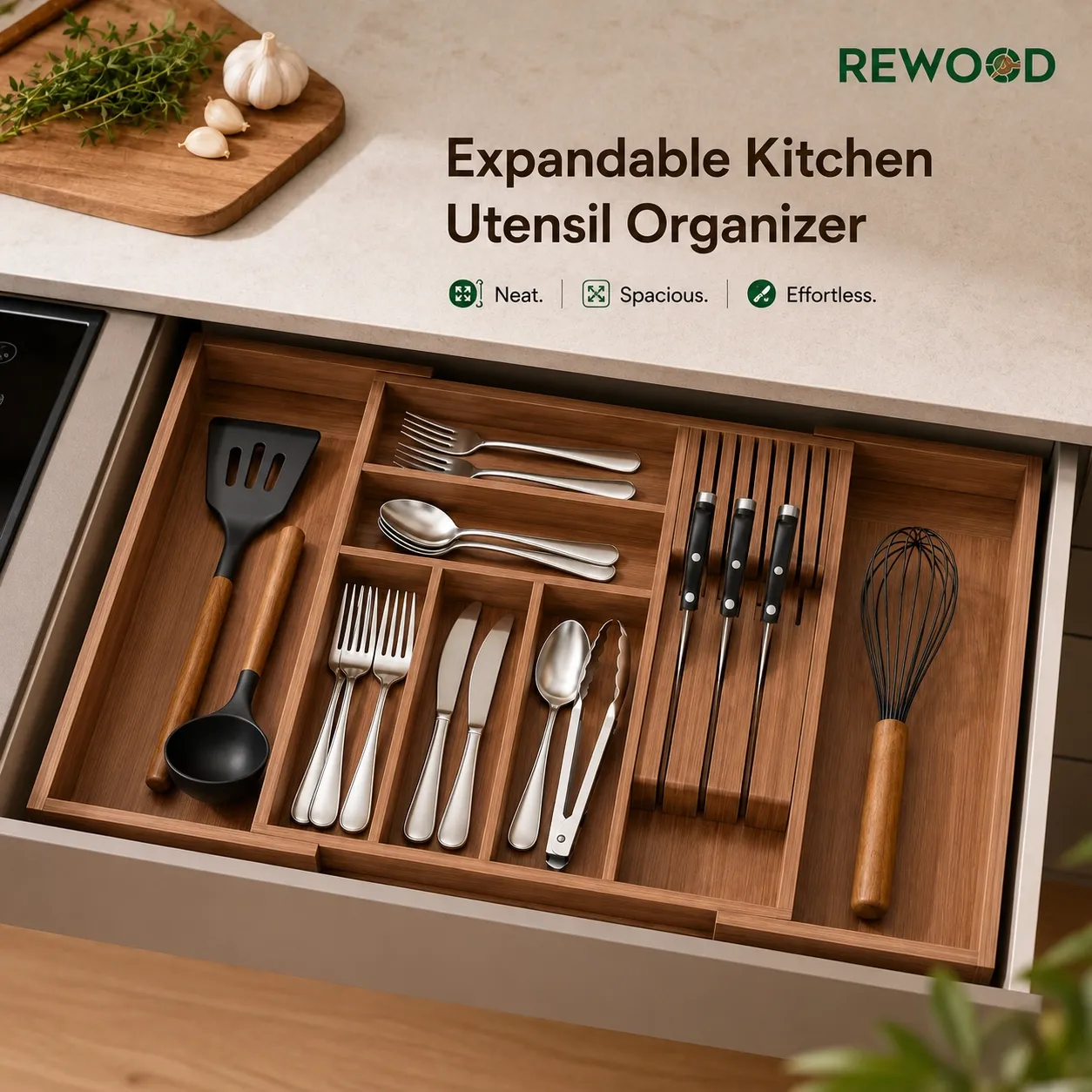
Sourcing a custom bamboo drawer organizer from China goes wrong less often in production than in definition. The recurring failures — an organizer that does not fit the drawers it was sold for, compartments smaller than the packaging promised, joints that loosen after a season of use — are usually locked in before the RFQ is even sent, in how the drawer, the dimensions and the expansion range were specified. This guide covers only what happens before the RFQ: how to define the target drawer, how to read size labelling critically, and which drawer-specific failure points to check on the sample. For product-type definitions and the OEM execution path from inquiry to quotation, see our guide to the OEM and private-label sourcing path for bamboo drawer organizers.
Start With the Drawer, Not the Organizer
An organizer is not sized against a cabinet catalogue page. It is sized against the inside of a drawer box, and nominal cabinet sizes describe the outside of the furniture, not the space the organizer has to live in.
United States. Kitchen cabinets are commonly built in 3-inch width increments, and drawer base cabinets are often 12 to 36 inches wide. The drawer box inside is narrower than the nominal cabinet width — side panels and drawer slides take up space on both sides — and clear depth and height are reduced by the box construction and the drawer front. Bathroom vanity drawers are usually narrower and shallower than kitchen drawers, and many have a U-shaped cut-out around plumbing that a full-width organizer cannot use.
Europe. System kitchens are planned in metric module widths; cabinet widths such as 300, 400, 450, 500, 600 and 800 mm are common. The same rule applies: the nominal module width is not the clear interior width of the drawer box, and European drawer systems lose interior space to their side and runner hardware.
The working rule for both markets:
- Specify the interior width, depth and clear height of the drawer box, measured on real furniture or taken from your channel's cabinet data — never the nominal cabinet size.
- State which market and which furniture line the fit range targets. A range that suits US kitchen drawers will not automatically suit European system drawers or vanity units.
- Check clear height as well as footprint. An organizer that fits the drawer floor can still foul the drawer front or a cross rail when the drawer closes.
Outer Dimensions vs Usable Inner Dimensions: Read the Labelling Critically
Most fit complaints trace back to one confusion: the size on the listing or carton is the product's outer dimension, while the buyer — and the end user — cares about the usable inner dimension of the compartments.
Three labelling traps appear again and again in this category:
- The headline size is the fully expanded outer size. A tray quoted at its maximum expanded width tells you nothing about its closed size, and nothing about the space inside its compartments.
- Wall and divider thickness comes out of the usable space. Frame walls, compartment dividers and sliding rails all consume millimetres. Two organizers with identical outer dimensions can offer noticeably different usable compartment widths.
- The "fits drawers from X to Y" range is ambiguous. On some listings the range describes the product's own extended length; on others, the drawer interior width it is meant to fit. These are not the same number, and confusing them is how a program ends up a size too large for its target drawer.
Verify labelling the way an inspector would, before any sample is approved:
- Require a dimension drawing on which every measurement is named — outer width closed, outer width expanded, outer depth, outer height, and the usable inner width and depth of the main compartments.
- Ask, for each headline number on the quotation and the packaging draft, one question: outer or inner? Get the answer in writing on the specification, not in a chat message.
- Ask what tolerance applies to the stated dimensions, and which dimension is controlled most tightly in production.
- Measure the sample yourself at the same named points, with the organizer closed and fully expanded, and record the readings against the drawing. A supplier whose sample matches its own drawing within its stated tolerance is a different risk from one whose numbers only exist on the listing.
The Expansion Range: Verify Both Ends, Not the Middle
An expandable organizer spends its life at the ends of its range, not in the middle of it. Check both ends on the sample:
- At the closed end: the organizer should sit stable in the narrowest target drawer, without rattling, rocking or leaving a gap that lets it slide every time the drawer opens.
- At full extension: the sliding sections should still be properly engaged — no sagging in the middle, no wide gap opening between sections, no sense that one more centimetre would separate the parts.
- Across the range: slide it open and closed repeatedly. The movement should stay smooth and even, without one side binding or the sections twisting out of parallel.
If the stated range cannot be reproduced on the sample with these results, the range on the packaging is a claim, not a specification — and it will come back as returns.
Sample-Stage Checks for Drawer-Specific Failure Points
General workmanship checks apply to any bamboo product. The points below are the ones specific to drawer organizers, where the product is handled, loaded and slid daily. Do them on the pre-production sample, not on the first bulk carton.
Corner and frame joints. Joints are the most reported failure point in this category: frames that separate at the corners after months of being pulled by one end. Load the organizer with typical drawer contents, lift and move it by one end and one corner, and look for any joint opening, creaking or movement. A joint that moves on the sample will not improve in bulk.
Sliding and spring mechanisms. Expandable sections and spring-loaded parts live on repeated movement. Cycle the mechanism repeatedly — dozens of times, not twice — and check that sliding stays even and that spring tension feels consistent from piece to piece across several samples, not just on the one approved unit.
Edges, divider tops and splinters. Run a hand, then a cloth, along every edge, divider top and compartment corner. Raised grain, sharp edges or splinters that snag the cloth will be found by end users within a week, and in a cutlery drawer they are a safety complaint, not a cosmetic one.
Flatness and warping. Place the organizer on a flat surface and check for rocking. Then check it again inside a real drawer. Bamboo and wood that is packed with too much moisture in it warps and cracks after arrival, which is why the moisture question belongs in the fit definition rather than after the goods land: Rewood dries its bamboo and wood to a moisture content below 12%, and buyers should ask any supplier for its moisture target in writing and hold the sample to it.
Compartment walls. Thin compartment dividers flex when a drawer is loaded and slammed. Press the walls, load the compartments unevenly, and confirm the layout still separates contents instead of bowing into the next compartment.
These sample-stage checks cover the product itself; the finished, packed goods still need a pre-shipment inspection and defect list agreed before production, so the bulk shipment is judged against the same points.
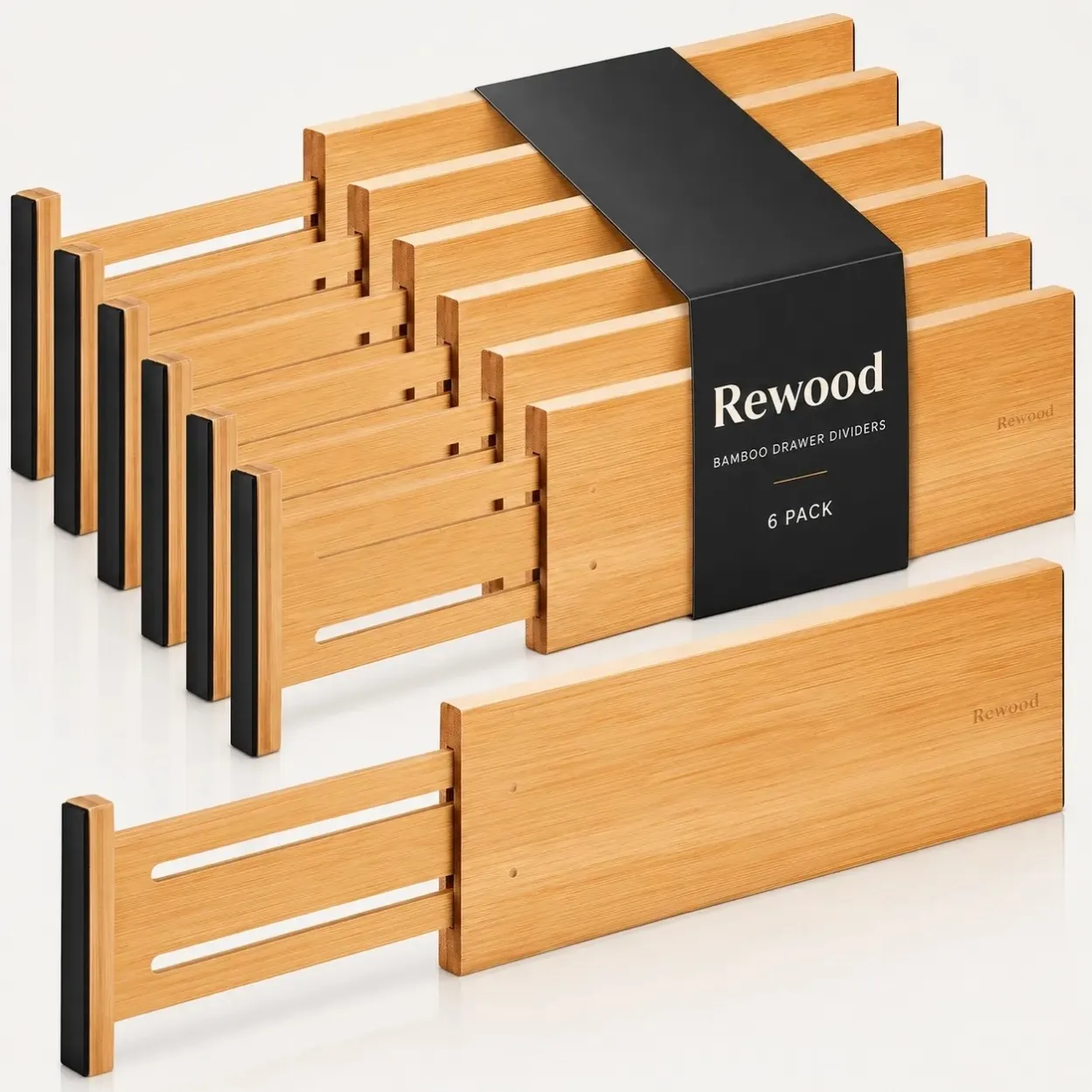
Record the Fit Definition Before You Send the RFQ
None of the checks above needs a long document. Before requesting a quotation, record one fit definition for the project:
- target market and furniture type (for example, US kitchen drawer bases, European system drawers, vanity drawers);
- target drawer box interior width, depth and clear height;
- required organizer outer dimensions, closed and expanded;
- required usable inner dimensions for the main compartments;
- the expansion range, defined as drawer interior width, with the tolerance you will accept;
- the sample checks from this guide that the approved sample must pass.
This is a definition record, not a second RFQ checklist: the full RFQ contents and the OEM process that follows sit in the OEM drawer organizer guide, and this article deliberately does not repeat them. A quotation requested against a recorded fit definition comes back comparable between suppliers; one requested against a listing link does not.
If the format itself is still open — an expandable tray or spring-loaded dividers — settle that choice first with our comparison of expandable drawer organizers vs drawer dividers, then record the fit definition for the format you chose.
How Rewood Handles This Definition Stage
Rewood manufactures bamboo and wood houseware at its own base in Longquan, Zhejiang. The reference product for this category is the custom bamboo expandable drawer organizer from the manufacturer, developed for importers, wholesalers, retailers and private-label brands that need the size definition, compartment layout and packaging confirmed before bulk production.
MOQ 500 pcs per design applies to products made by Rewood; partner-sourced items are confirmed per item with the supplier. For Rewood-made organizers, samples typically take 7–15 days and production typically 20–35 days after sample confirmation — time that is only well spent if the sample is checked against the fit definition, not just looked at.
Frequently Asked Questions
What is the difference between outer dimensions and usable inner dimensions?
The outer dimension is the full footprint of the organizer, including frame walls and sliding sections. The usable inner dimension is the space actually available inside the compartments, after wall and divider thickness is taken out. Fit and capacity complaints usually come from a program specified on outer dimensions but sold to end users on the space they expected inside.
How do I verify a stated expansion range before ordering?
Reproduce it on the sample. Measure the organizer closed and fully expanded, install it in the narrowest and widest target drawers, and check stability at the closed end and section engagement at full extension. Confirm in writing whether the range describes the product's own length or the drawer interior width it fits, and record the tolerance you accept.
What usually makes bamboo drawer organizers fail in the field?
The drawer-specific points: corner joints separating under repeated handling, sliding sections that sag or bind at full extension, splinters and raised edges, and warping from material packed with excess moisture. All four are detectable on a pre-production sample with the checks in this guide; none of them is reliably detectable from photographs or a listing.
What is the MOQ and lead time for custom bamboo drawer organizers?
MOQ 500 pcs per design applies to products made by Rewood; partner-sourced items are confirmed per item with the supplier. For Rewood-made products, samples typically take 7–15 days, and production typically takes 20–35 days after sample confirmation. Exact timing follows the confirmed specification, logo and packaging requirements.
To get a quotation you can compare, send the fit definition with your inquiry: target market, drawer interior dimensions, required outer and usable inner dimensions, expansion range and estimated quantity. Send your RFQ to info@rewoodoffice.com or message us on WhatsApp at +86 15024561325 — we reply within 24 hours.
Author: Jessie Jiang, Overseas Business Development, Rewood Houseware
Reviewed by: Rewood Product Development & Quality Control Team
Last updated: November 27, 2026