
Expandable Drawer Organizers vs Drawer Dividers: A Buyer's Guide
Expandable tray or spring-loaded dividers? Compare both bamboo drawer systems by drawer depth, contents, channel and packaging before you order.
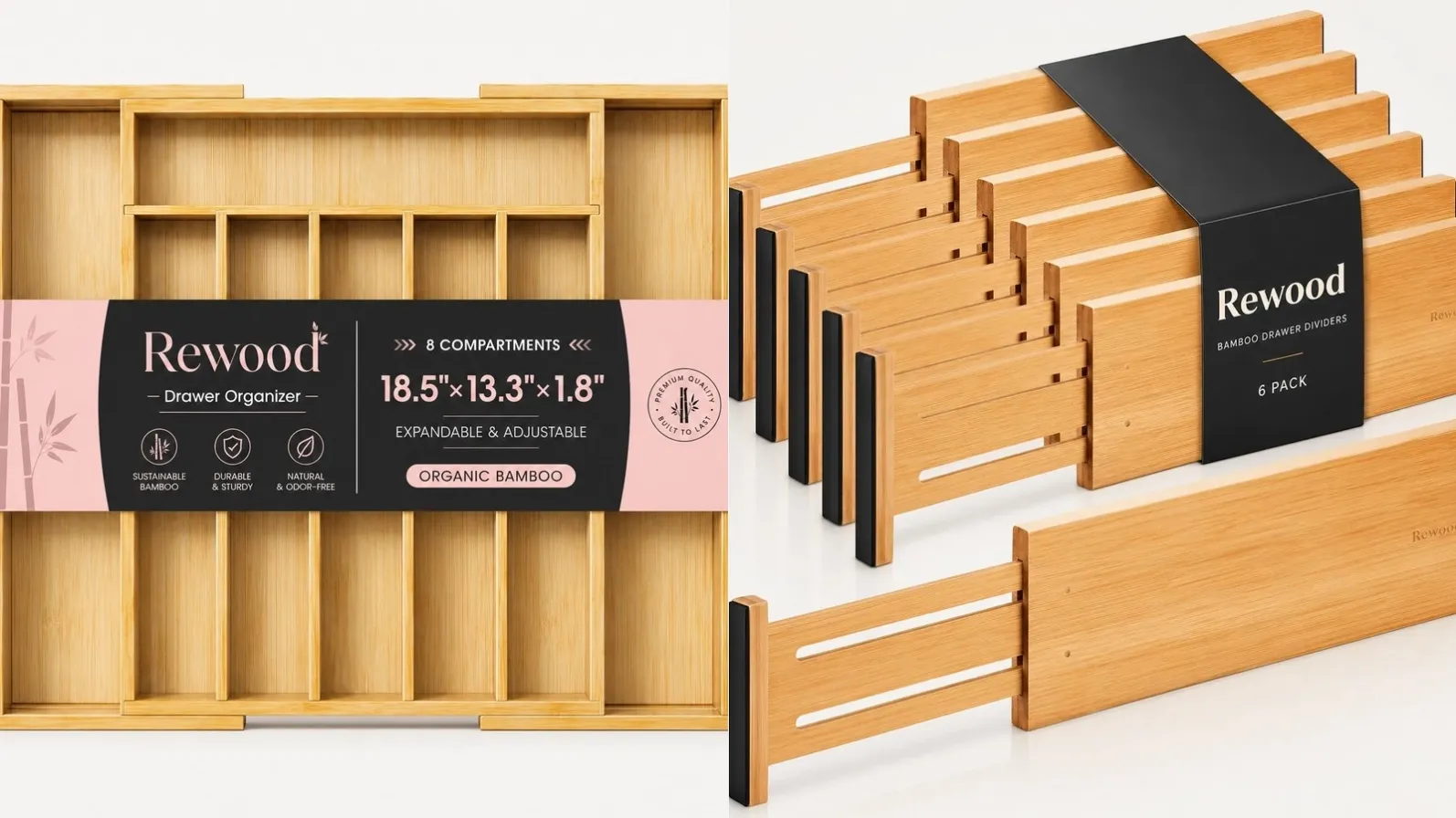
Expandable drawer organizers and drawer dividers are both sold as "bamboo drawer organizers," but they solve the drawer problem in different ways. Choose the expandable tray when the drawer needs fixed compartments for a defined set of items, such as cutlery. Choose spring-loaded dividers when the drawer contents vary, the drawer is deep, or one adjustable product has to fit many drawer widths across a retail program. Many kitchen programs end up ordering both — one format per drawer type. The sections below take that decision in order: drawer first, contents second, channel third, packaging and cost structure last.
The Two Formats in Brief
An expandable drawer organizer is a tray that sits inside the drawer. Its width extends to fit the drawer, and its compartments are built in. Rewood's custom bamboo expandable drawer organizer expands from 6 slots to 8 compartments and measures 18.5 × 13.3 × 1.8 in (47 × 33.8 × 4.6 cm) when expanded, so it is a low-profile tray made for standard kitchen drawers.
Drawer dividers are separate spring-loaded bamboo pieces. Each piece compresses, sits between two drawer walls and holds itself in place with spring tension and EVA foam ends — no fixed compartments, no tray base. Rewood's custom bamboo drawer dividers come as a 6-pack, adjustable from 12.5–17 in (31.8–43.2 cm), 4.65 in (11.8 cm) high and 0.6 in (1.5 cm) thick.
These definitions follow the product-type breakdown in our OEM guide to bamboo expandable drawer organizers and dividers, which covers the OEM and private-label sourcing path for both formats. This article stays on the question that comes before that path: which format belongs in your program at all. Once the format is chosen, the fit still has to be defined precisely — drawer dimensions, labelling checks and sample-stage failure points are covered in our guide to sourcing custom bamboo drawer organizers from China.
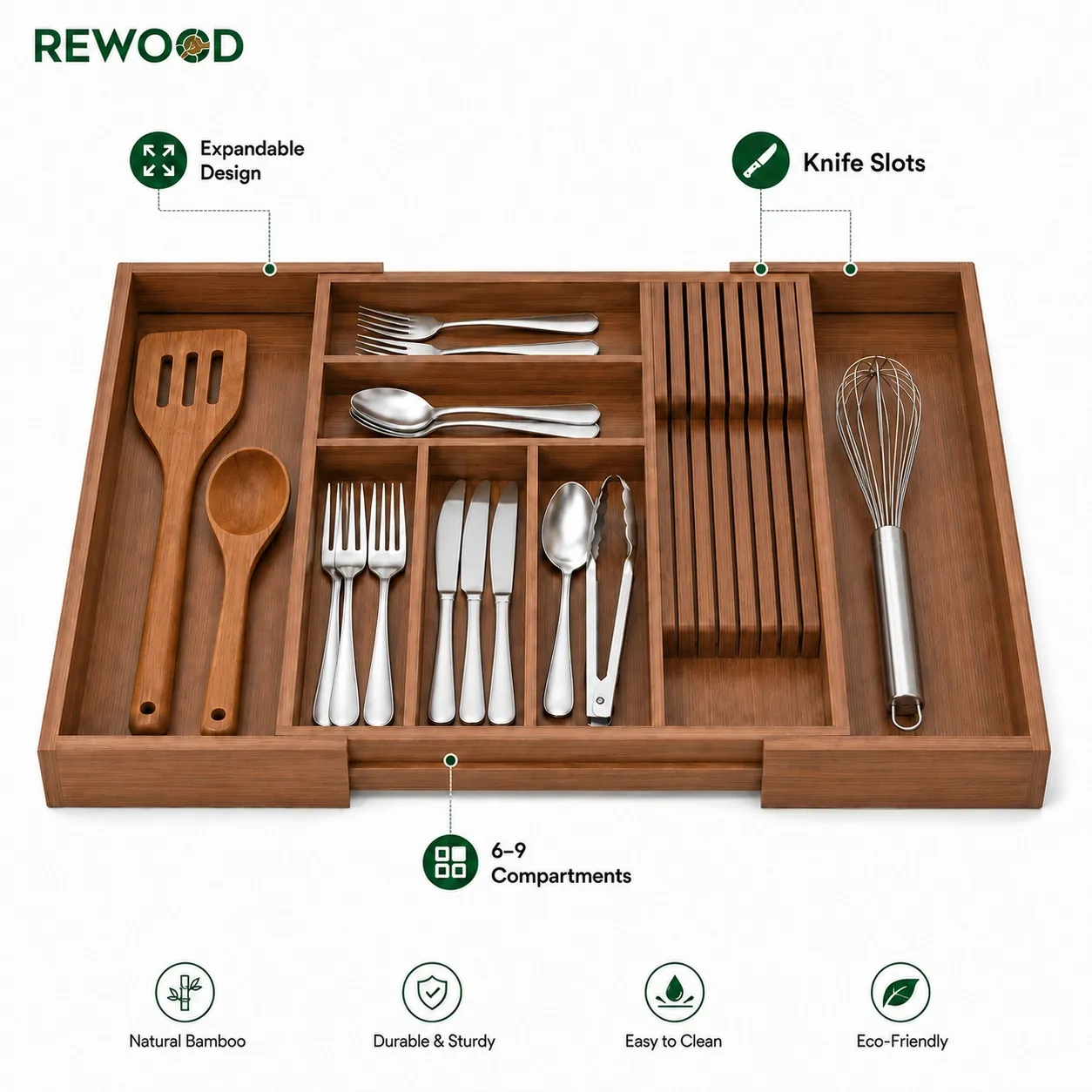
Same drawer problem, two structures: a compartment tray fixes the layout; loose dividers let the layout change.
Side-by-Side: The Decision Factors That Actually Differ
| Decision factor | Expandable tray organizer | Spring-loaded divider set |
|---|---|---|
| Layout | Fixed compartments; the tray decides where items go | Open sections; the end user decides where items go |
| Fit logic | One tray per drawer; width expands to a set maximum | Each piece spans 12.5–17 in; several pieces can section one wide drawer |
| Height profile | 1.8 in — suits shallow drawers | 4.65 in — suits deeper drawers |
| Best contents | Defined sets: cutlery, utensils, gadget assortments | Variable contents: bulk utensils, bottles, clothing, mixed items |
| Retail unit | One tray per retail pack | Multi-piece set (6-pack reference) |
| Rooms covered | Kitchen first | Kitchen, dresser, closet and office drawers |
| Packaging shape | One rigid, full-size tray per unit | Flat pieces that stack into a compact set |
| Branding surface | Tray base and compartment walls | The face of each divider piece |
Choose by Drawer: Depth First, Then Width
Drawer depth is the fastest filter. A tray that stands 1.8 in high fits the shallow cutlery drawers found in most kitchens and leaves clearance for the drawer to close over tall handles and stacked cutlery. A divider that stands 4.65 in high needs a deeper drawer; in a shallow drawer it can sit proud of the drawer walls and interfere with closing. Buyers speccing for deep kitchen drawers, dresser drawers or storage drawers will usually find the divider height an advantage rather than a limit, because taller sections keep bottles, rolled clothing and stacked items from sliding over the top.
Width works differently in each format. The tray is a single footprint: it expands sideways to fill one drawer, and once it reaches its expanded limit, any remaining space beside it is unorganized. Dividers work piece by piece. Each one adjusts across its 12.5–17 in span, so a buyer can place two, three or more in one wide drawer, run them front-to-back or side-to-side, and re-space them when the contents change. For programs sold into markets with mixed drawer widths, that per-piece adjustment is the main reason dividers are easier to standardize as one SKU: the same set covers a range of drawer sizes instead of one tray footprint per size band.
Layout control is the trade-off. A tray gives every end user the same compartment map, which is why cutlery and utensil programs photograph well and review well. Dividers give up that fixed map in exchange for flexibility — the sections are whatever the user makes them, which suits drawers whose contents change from week to week.
Choose by What Goes Inside
- Cutlery and flatware sets — the tray. Compartments sized for forks, knives and spoons keep a defined set in order, and the set either fits its slot or it does not; there is nothing for the user to misconfigure.
- Cooking utensils and gadgets — depends on the drawer. A defined gadget assortment with a place for each tool suits a tray; a deep drawer of mixed ladles, tongs and openers suits dividers, because the items vary in length and the sections can move.
- Office and desk drawers — usually dividers for mixed stationery, cables and accessories that change over time; a tray works when the brand sells a fixed desk-set configuration.
- Cosmetics and dresser drawers — dividers are the common choice, because bottles and jars vary in height and the drawer is usually deep enough for the 4.65 in profile; trays appear in shallow vanity drawers sold as a defined organizer set.
What decides it is how fixed the assortment is: a set that stays the same belongs in a tray, and a drawer of changing contents is divider territory.
Choose by Channel and Retail Program
Single hero SKU vs multi-piece set. A tray program is built around one hero product per drawer size — straightforward for a kitchen brand's flagship listing or a retail planogram slot. A divider program is built around a set: the 6-pack is the retail unit, and the value story is pieces-per-pack and rooms-per-pack rather than one perfect fit. Private-label brands that sell across kitchen, bedroom and office categories often prefer dividers for that cross-room story; kitchen-focused brands usually anchor on the tray. If dividers are your lead format, the deeper question of whether bamboo drawer dividers work as a private-label product — pack economics, branding space and range fit — is assessed in full in our divider private-label guide.
Shelf presentation differs. A tray's retail box is the size of the tray, so the shelf footprint and the product footprint are the same thing — what the shopper sees on the box is what fills the drawer. Divider sets pack flat and small relative to the drawer area they organize, so they suit peg, shelf-edge and multi-facing displays where a full-size tray box would take too much room.
Returns risk sits in different places. Tray programs fail on fit: if the expanded width misses the customer's drawer, the product comes back. Divider programs fail on expectation instead — the shopper wanted fixed compartments, got loose pieces, and sends the set back. Whichever format you choose, the size chart and the product-type wording on the packaging carry the returns risk — name the format plainly and show the drawer measurements it covers.
Packaging and Cost Structure: Where the Money Sits
Neither format is simply "cheaper." The cost sits in different places, and buyers comparing quotations should compare the structure, not a headline unit price.
- Material and construction. The tray is one large joined bamboo unit with compartment walls — more panel area and joinery per retail unit. A divider set spreads its material across several simpler pieces, plus the spring mechanism and EVA end pads that a tray does not have.
- Packaging volume per retail unit. A tray ships at roughly its working size: one rigid unit per box, and the box volume follows the expanded footprint. Divider pieces stack flat, so a 6-pack occupies a compact box relative to the drawer space it covers — usually the denser of the two formats per carton and per container.
- Freight sensitivity. Because of that volume difference, tray programs are more sensitive to carton and container efficiency when the order scales; divider programs are more sensitive to piece count and set configuration, since adding pieces adds material and packing labor to every set.
- Branding cost placement. Logo work on a tray concentrates on one unit. On dividers, the same logo decision repeats across every piece in the set, which changes both the branding effect at retail and the per-set application work.
State the format, the set configuration and the packaging expectation when you ask for pricing, because a quotation for one structure says nothing about the other. Our guide to MOQ for custom bamboo houseware explains the quantity side of that conversation in detail.
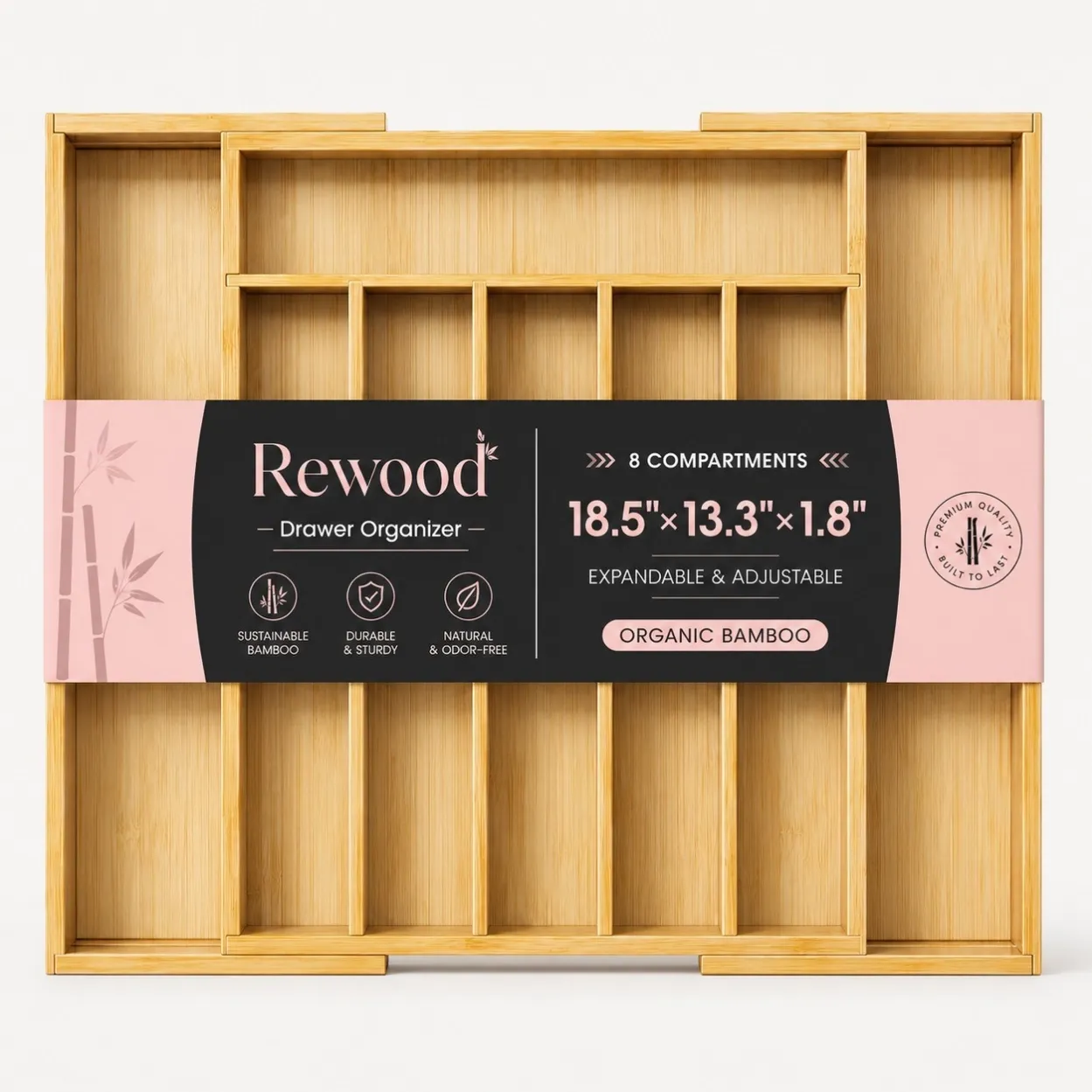
Packaging volume per retail unit is the clearest structural cost difference between the two formats.
When the Right Answer Is Both
Experienced kitchen programs rarely standardize on one format for every drawer, because a kitchen is not one drawer type. The common pattern is a tray in the shallow cutlery drawer, where the assortment is fixed, and dividers in the deep utensil and gadget drawers, where contents vary and the taller profile earns its space. In an oversized drawer, dividers can also section the space a tray does not cover.
For home organization brands, the same logic runs across rooms: the tray anchors the kitchen offer, and divider sets carry the range into dresser, closet and office drawers under one brand and one packaging system.
How combined ordering works. Treat the two formats as two designs in one program, not as one product with options. Each format is sampled and approved on its own specification, and the order is placed per design. On quantities, the standing rule is: MOQ 500 pcs per design applies to products made by Rewood; partner-sourced items are confirmed per item with the supplier. For Rewood-made programs, samples typically take 7–15 days and production typically 20–35 days after sample confirmation, with each format's sample approved before its production slot is set.
How Rewood Supports Both Formats
Rewood manufactures both formats at its Longquan bamboo and wood base and supports OEM and private-label programs for importers, distributors, retailers and home organization brands. Buyers can review the custom bamboo expandable drawer organizer for tray programs and the custom bamboo drawer dividers for divider sets, then confirm the drawer sizes, set configuration and packaging direction for their market before sampling starts.
Frequently Asked Questions
Which format is better for a cutlery drawer?
The expandable tray, in almost every case. Cutlery is a fixed assortment, and fixed compartments keep each piece in place, present the set well at retail and remove the layout decisions that cause divider returns in shallow drawers. The tray's 1.8 in profile is also built for standard shallow cutlery drawers.
Can drawer dividers replace an expandable tray entirely?
For deep or mixed-content drawers, yes — dividers can organize the whole drawer. As a full range replacement, usually no: dividers cannot reproduce the fixed compartment map that cutlery and defined utensil sets need, so most programs keep the tray for the cutlery drawer and use dividers where flexibility matters more.
Which format is easier to sell across different drawer sizes?
Dividers. Each piece adjusts across its 12.5–17 in span and pieces can be added or re-spaced, so one set covers more drawer widths. A tray covers the width band of its own expanded footprint, so a tray range aimed at several drawer sizes usually needs more than one tray size in the program.
Can I order trays and dividers in one combined program?
Yes. The two formats are ordered as separate designs — each sampled and approved on its own specification — and can run under one brand, one packaging system and one shipment plan. MOQ 500 pcs per design applies to products made by Rewood; partner-sourced items are confirmed per item with the supplier.
Which format gives better shelf impact for a private-label launch?
It depends on the launch story. A tray gives one large, photographable hero product whose box matches the drawer it fills. A divider set gives a compact box with a pieces-per-pack value story and cross-room use. Kitchen-led launches usually open with the tray. Whole-home launches more often start from the set, since it is the format that travels across rooms.
To choose the format for your drawer program, send us your target drawer sizes, the items each drawer should hold, your sales channel and your packaging direction through our contact page, or email info@rewoodoffice.com. We will confirm which format — tray, dividers, or a combined program — fits each drawer type before sampling.
Author: Jessie Jiang, Overseas Business Development, Rewood Houseware
Reviewed by: Rewood Product Development & Quality Control Team
Last updated: November 27, 2026