B2B Buying & Sourcing Guides
How to Specify a Bamboo Bread Box for Private Label & OEM Orders
Learn how to specify a bamboo bread box for OEM and private-label orders, including dimensions, structure, acrylic doors, ventilation, packaging, samples and QC.
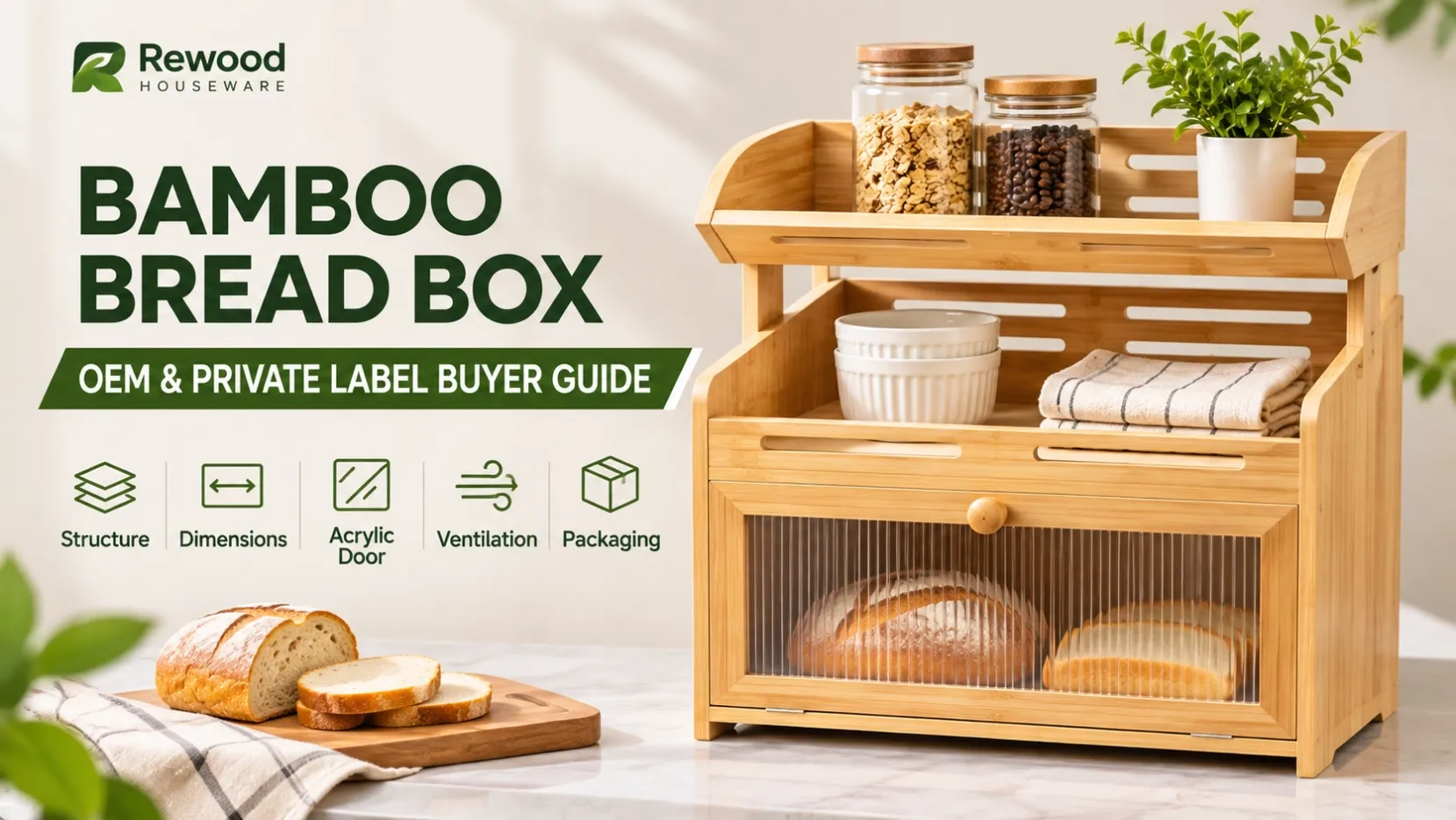
If you are sourcing a bamboo bread box for a private-label or OEM program, do not begin with only a reference photo and the request:
“Please quote this bread box.”
Before comparing prices, define the product around five core decisions:
- Structure
- Usable dimensions
- Door and access design
- Ventilation and storage layout
- Private-label packaging and QC requirements
Terms such as large bread box, double-layer bread box or bread box with window are not precise enough for bulk purchasing.
Two products can look similar in a marketplace image but differ significantly in internal dimensions, countertop footprint, door clearance, ventilation layout, assembly method and packaging volume.
This guide explains how importers, retailers, distributors and private-label kitchen-storage brands can turn a bamboo bread box idea into a clearer RFQ, sample specification and bulk-order QC standard.
Quick Answer: What Should a Bamboo Bread Box Buyer Specify?
Before requesting a final quotation, confirm:
Specification Area | Buyer Should Define |
|---|---|
Structure | Single-tier, double-tier, top-storage, corner or multifunction |
Exterior Size | Length × depth × height |
Interior Size | Usable storage dimensions |
Counter Footprint | Space required on the countertop |
Door | Acrylic or other panel, opening direction and closure |
Ventilation | Location and required vent configuration |
Top Storage | Flat top, raised shelf or no additional storage |
Internal Layout | Single compartment, shelf or multiple zones |
Assembly | Fully assembled or knock-down, if applicable |
Logo | Position, size and branding method |
Packaging | Retail, e-commerce or wholesale requirement |
Sample QC | Dimensions, fit, door function, surface and packaging |
Bulk QC | Approved-sample consistency and packing accuracy |
The key rule is:
Specify the usable product—not just the appearance.
1. Choose the Bread Box Structure Before Comparing Prices
“Bamboo bread box” describes a product category, not one standard construction.
Different structures serve different buyer and consumer needs.
Single-Tier Front-Door Bread Box
This format uses one main enclosed storage compartment.
It can be appropriate when the buyer wants:
- A relatively simple structure
- Easy front access
- Moderate countertop height
- One main bread-storage zone
Some versions may also include an additional top storage surface.
Double-Tier Bread Box
A double-tier structure adds vertical storage rather than increasing only the countertop footprint.
It may suit buyers who want:
- Separate storage zones
- More vertical capacity
- A larger visual presence on the counter
However, the buyer should also check:
- Overall height
- Door clearance
- Internal shelf dimensions
- Space below kitchen wall cabinets
More storage is useful only if the product still fits the intended kitchen environment.
Bread Box With Top Storage
A bread box with a raised top shelf combines enclosed bread storage with an additional open storage area.
This can be useful for countertop organization, but buyers should define:
- Overall product height
- Top-shelf dimensions
- Whether the shelf has raised edges
- Available load area
- Whether items placed on top interfere with the door
For one current Rewood reference configuration, buyers can review our bamboo bread box with acrylic door and top shelf.
Corner Bread Box
Corner structures use a different footprint to fit against kitchen walls or into countertop corners.
When developing this type of product, exterior width alone is not enough.
Buyers should also check:
- Internal usable area
- Door-opening geometry
- Depth
- Countertop footprint
Multifunction Bread Box
Some bread-storage products combine enclosed bread storage with additional open storage functions.
A multifunction structure may include:
- Bread storage
- Fruit storage
- Open shelving
- Additional organization areas
This creates a broader kitchen-storage product, but it also introduces:
- More components
- More assembly points
- Greater total height
- Larger packaging requirements
- Additional QC checkpoints
Buyers considering this direction can also compare Rewood's 3-in-1 bamboo bread box with fruit basket product page when evaluating different bread-storage structures.
2. Do Not Specify Size Only as Small, Large or Extra Large
For OEM purchasing, words such as:
- Small
- Large
- Extra large
- Family size
are not technical specifications.
The RFQ should use actual measurements.
At minimum, confirm:
Exterior Size = Length × Depth × Height
This helps define:
- Countertop footprint
- Overall height
- Product proportions
- Approximate packaging volume
But exterior dimensions are only the first step.
3. Interior Dimensions Are Often More Important Than Exterior Dimensions
The buyer is ultimately purchasing usable storage space.
A bread box may have a large exterior while losing internal capacity because of:
- Bamboo panel thickness
- Door framing
- Shelves
- Internal supports
- Raised bases
- Hardware
For this reason, ask for both:
Exterior dimensions
and
Usable interior dimensions
A complete specification may include:
- Overall exterior length
- Overall exterior depth
- Overall exterior height
- Internal storage length
- Internal storage depth
- Internal storage height
- Door-opening width
- Door-opening height
This creates a more useful comparison than simply asking whether the product is “large capacity.”
For reference, Rewood's current acrylic-door/top-shelf bamboo bread box is listed with exterior dimensions of approximately 15.75 × 9.84 × 10.24 in, while the usable internal space is approximately 14.95 × 9.04 × 7 in.
This illustrates why exterior and interior measurements should both be included in a professional RFQ.
4. Define the Product Around the Target Use
The correct bread-box dimensions depend on what the buyer expects consumers to store.
Possible use cases include:
- Packaged sandwich bread
- Homemade loaves
- Rolls
- Bagels
- Pastries
- Several smaller bakery items
- Mixed bread and countertop-storage use
Do not assume that one universal bread-box size works equally well for every market.
For private-label development, buyers should compare the usable interior space against representative products from their target market.
If capacity is commercially important, define it through measurable dimensions rather than relying only on a marketing phrase such as:
“Fits two loaves.”
Specific capacity claims should be validated against the actual product and intended contents.
5. Check Countertop Footprint and Cabinet Clearance
Capacity is only one side of the product decision.
A bread box is normally used on a countertop, so its external geometry affects where consumers can place it.
Before confirming a taller design, consider:
- Countertop depth
- Overall footprint
- Height below wall cabinets
- Door-opening space
- Space required above the product
- Whether objects will be stored on the top surface
A tall multi-level design may offer more storage but may not suit every kitchen.
A wider single-tier design may reduce height but occupy more working counter space.
There is no universally best structure.
The right choice depends on the target market, customer profile and product positioning.
6. What Should Buyers Check on an Acrylic Door?
Acrylic front panels are commonly used because they allow users to see the contents without completely opening the bread box.
For OEM sourcing, however, “acrylic door” is still incomplete as a specification.
Buyers should confirm:
- Clear, translucent or patterned appearance
- Panel dimensions
- Panel thickness if relevant to the project
- Door-frame structure
- Opening direction
- Hinge or connection method
- Handle design where applicable
- Closure method
- Alignment when closed
- Surface-scratch acceptance standard
Rewood's current bamboo bread box reference uses an acrylic front door with magnetic closure.
For this type of design, the sample should be checked to confirm:
- The door closes consistently
- The magnetic points align correctly
- The door is not excessively difficult to open
- The panel sits correctly within the surrounding structure
- The door remains aligned after assembly and handling
The acrylic panel should be evaluated as part of the complete door mechanism rather than only as a transparent decorative feature.
7. Ventilation Should Be Defined as a Physical Product Feature
Ventilation is a common feature in bread-box designs.
For an OEM specification, buyers should define what is physically required.
This may include:
- Rear ventilation holes
- Side ventilation openings
- Vent position
- Number of openings
- Hole dimensions
- Layout
Rewood's current acrylic-door/top-shelf bread box includes rear ventilation holes.
However, buyers should avoid automatically turning a physical ventilation feature into an unsupported performance claim.
For example, a supplier should not assume that ventilation alone proves statements such as:
“Keeps bread fresh for seven days.”
Actual storage performance can depend on:
- Bread type
- Packaging
- Environmental temperature
- Humidity
- Ventilation design
- Storage conditions
For private-label packaging and marketing copy, specific freshness-performance claims should therefore be supported separately.
8. Top Shelf vs. Second Enclosed Tier: They Solve Different Problems
A raised top shelf and a second enclosed bread-storage compartment are not the same structure.
Raised Top Shelf
A top shelf adds open countertop-storage space.
It may be useful for:
- Small kitchen accessories
- Packaged food
- Coffee or tea accessories
- Jars
- Other lightweight countertop items
Its commercial value is additional organization rather than additional enclosed bread capacity.
Second Enclosed Tier
A double-tier bread box creates another enclosed storage compartment.
This changes:
- Overall height
- Internal capacity
- Door quantity
- Hardware
- Assembly
- Packaging
- Product cost
Buyers should therefore decide whether their product concept needs:
additional open storage
or
additional enclosed storage
before requesting a final quotation.
9. When Does a Bread Box + Fruit Basket Structure Make Sense?
A bread box combined with a fruit basket moves beyond simple bread storage and into broader countertop kitchen organization.
The buyer is no longer sourcing only one enclosed bread compartment.
A multifunction design may combine:
- Enclosed bread storage
- Open fruit storage
- An intermediate shelf
- Additional organization areas
This type of product may suit brands that want a larger multifunction kitchen-storage SKU.
However, the development process should also evaluate:
- Overall dimensions
- Total height
- Base stability
- Basket structure
- Component quantity
- Assembly
- Packaging volume
- Carton protection
A multifunction design should be treated as a complete storage system rather than simply as a standard bread box with one extra accessory.
Buyers interested in this direction can review Rewood's 3-in-1 bamboo bread box with fruit basket as a separate product concept.
10. Assembly Should Be Confirmed Before Packaging Is Designed
Do not assume the assembly method from a product photograph.
Before finalizing packaging, ask:
- Is the product supplied fully assembled?
- Is customer assembly required?
- Which components are separated?
- Is hardware included?
- Are tools required?
- Are assembly instructions required?
- What parts must the customer install?
For a knock-down structure, the sample approval should include the actual assembly process.
Check:
- Hole alignment
- Hardware fit
- Panel alignment
- Door movement after assembly
- Final squareness
- Component completeness
A visually acceptable factory sample is not enough if the retail customer will receive the product in a different assembly configuration.
11. Packaging Should Follow the Bread Box Structure
Bread boxes can occupy significant carton volume, especially when supplied fully assembled.
Packaging should therefore be considered during product development rather than after the product structure has already been locked.
For each project, confirm:
- Individual packaging method
- Product orientation
- Surface protection
- Acrylic-door protection
- Internal movement
- Accessory placement
- Hardware placement
- Assembly instructions where applicable
- Barcode and SKU labels
- Export-carton quantity
For a more detailed packaging framework, buyers can also review our private-label packaging guide for bamboo and wood houseware.
The packaging decision should balance:
retail presentation + product protection + carton efficiency + landed cost
rather than focusing only on box appearance.
12. Private Label Development Should Start With the Product Specification
Before preparing packaging artwork, confirm the actual bread box.
A practical development sequence is:
Structure → Dimensions → Sample → Function → Logo → Packaging → Bulk Production
not:
Packaging Artwork → Product Changes → Box No Longer Fits
For a private-label bread-box project, confirm:
Product
- Material
- Structure
- Exterior dimensions
- Interior dimensions
- Shelf configuration
- Door design
- Ventilation
- Assembly
Branding
- Logo location
- Logo dimensions
- Branding method
- Artwork
Packaging
- Individual package
- Retail presentation
- Barcode
- SKU
- Instructions
- Export carton
This sequence reduces late-stage packaging changes and unnecessary rework.
13. What Should Be Checked on the Bread Box Sample?
The sample should become a practical reference for bulk production.
A useful sample review can include:
Sample Check | What to Confirm |
|---|---|
Overall Size | Matches agreed exterior dimensions |
Interior Space | Matches agreed usable dimensions |
Structure | Correct tier or shelf configuration |
Bamboo Surface | Acceptable appearance and workmanship |
Corners & Edges | Smooth and properly finished |
Door | Opens and closes correctly |
Acrylic Panel | Correct appearance and fit |
Closure | Magnet or other closure aligns correctly |
Ventilation | Correct location and configuration |
Shelf | Correct position and dimensions |
Assembly | Parts fit correctly if applicable |
Logo | Position, size and appearance |
Packaging | Product fits and is adequately protected |
Components | Correct quantity and accessories |
The approved sample should be connected to a written specification rather than relying only on photographs or memory.
14. Acrylic Panels Need Their Own QC Check
When a bread box includes an acrylic panel, the buyer should treat it as a separate visible component during QC.
Typical checks may include:
- Surface scratches
- Edge condition
- Panel fit
- Clarity or specified visual appearance
- Alignment
- Movement within the door frame
- Protection during packing
If protective film is used during manufacturing or shipment, the packing specification should clearly define whether that film remains on the product until final customer use.
The important point is that a transparent panel can make minor cosmetic defects more visible than on an opaque wooden surface.
15. Bamboo Surface and Edge Quality Affect Perceived Product Value
Bread boxes are relatively large countertop products.
That means buyers see significant areas of bamboo surface.
Sample and bulk inspections should therefore consider:
- Rough fibers
- Splinters
- Chipped corners
- Visible glue residue
- Strong surface scratches
- Open joints
- Uneven edges
- Obvious appearance outliers
Bamboo is a natural material, so variation in grain and tone can occur.
The objective is not to force every unit to look artificially identical.
The buyer should instead define an acceptable appearance range based on the approved sample and commercial positioning.
16. Door Alignment Is a Functional QC Point
For a front-door bread box, door alignment affects both appearance and function.
During bulk inspection, check:
- Door position when closed
- Gap consistency
- Closure alignment
- Opening resistance
- Hinge or connection movement
- Acrylic-panel fit
- Contact between the door and surrounding structure
A product can have correct exterior dimensions but still feel poorly made if the front door is visibly misaligned.
For this reason, functional door checks should remain part of bulk QC.
17. Bulk QC Should Focus on Repeatability
A good sample proves that one unit can be produced correctly.
Bulk production must prove that the same specification can be reproduced consistently.
Important bulk checks may include:
- Exterior dimensions
- Interior dimensions
- Panel alignment
- Door operation
- Magnetic closure where applicable
- Vent positions
- Bamboo surface
- Edge finishing
- Shelf alignment
- Assembly holes
- Component quantity
- Logo position
- Packaging
- SKU labels
For mixed-SKU orders, product identification becomes especially important because similar bread-box structures can be difficult to distinguish after final packing.
18. Packaging QC Should Include More Than the Retail Box
A private-label buyer should evaluate the complete packaging system.
This can include:
Individual Product Packaging
Check:
- Product fit
- Surface protection
- Acrylic-panel protection
- Internal movement
- Accessory placement
- Instructions
- Barcode
- SKU
Export Carton
Check:
- Quantity per carton
- Carton dimensions
- Gross weight
- Product orientation
- Shipping marks
- Warehouse labels where required
A beautiful retail package can still create problems if the master carton allows excessive movement or uses unnecessary shipping volume.
19. Packaging Size Can Affect Landed Cost
Bread boxes are relatively bulky compared with many small bamboo kitchen products.
This makes packaging efficiency commercially important.
Buyers should consider:
- Individual package dimensions
- Units per master carton
- Carton CBM
- Gross weight
- Pallet configuration where applicable
- Container utilization
- E-commerce parcel dimensions
A few centimeters added to an individual retail box may appear insignificant.
But across hundreds of units, that change can affect:
- Export-carton dimensions
- Total shipment CBM
- Freight cost
- Warehouse handling
Packaging design should therefore be reviewed together with landed cost.
20. How to Write a Better Bamboo Bread Box RFQ
Instead of sending:
“Please quote your bamboo bread box.”
send a structured brief such as:
Product: Bamboo Bread Box
Structure: Single-tier with front acrylic door and top storage shelf
Target Exterior Size: [insert size]
Target Interior Size: [insert size]
Door: Acrylic front panel
Closure: [confirm requirement]
Ventilation: [confirm location / configuration]
Logo: [laser / print / to be discussed]
Packaging: Private-label retail packaging
Quantity: [insert quantity]
Target Market: [country / region]
Sales Channel: [retail / Amazon / e-commerce / distributor]
Delivery Destination: [city / country or warehouse]
If the final structure is not yet decided, send reference photos for two or three preferred formats and ask the supplier to compare feasibility.
This creates a much more useful first quotation than a product photo alone.
Buyers preparing a new sourcing project can also review our guide to requesting a quote for custom bamboo and wood houseware.
21. Bamboo Bread Box Buyer Checklist
Before approving a bread-box project, confirm:
Product Decision
- Structure selected
- Target dimensions confirmed
- Interior dimensions checked
- Countertop footprint considered
- Door style confirmed
- Top storage confirmed
- Ventilation defined
- Assembly method confirmed
Private Label
- Logo position confirmed
- Artwork approved
- SKU or barcode requirements confirmed
- Packaging direction approved
Sample
- Dimensions checked
- Door tested
- Closure checked
- Surface inspected
- Vent configuration checked
- Assembly tested where applicable
- Packaging fit confirmed
Bulk Order
- Approved sample retained as reference
- QC criteria confirmed
- Component count defined
- Packaging specification locked
- Export-carton configuration confirmed
- Shipping labels and carton marks confirmed
22. Common Bamboo Bread Box Sourcing Mistakes
Mistake 1: Choosing Only by Exterior Appearance
Two similar-looking bread boxes may have very different usable capacity and internal structures.
Mistake 2: Asking Only for Exterior Dimensions
Internal storage dimensions can be more important to the end user.
Mistake 3: Using “Large Capacity” as a Specification
Use actual dimensions rather than marketing terminology.
Mistake 4: Ignoring Countertop Height
A taller design may not fit beneath every kitchen wall cabinet.
Mistake 5: Treating an Acrylic Door as Only a Visual Feature
The panel, alignment, closure and scratch control also require QC.
Mistake 6: Making Unsupported Freshness Claims
Ventilation features should not automatically be converted into specific shelf-life claims.
Mistake 7: Designing Packaging Before the Product Is Stable
Changes in dimensions or structure can make printed packaging unusable.
Mistake 8: Approving Only One Perfect Sample
Bulk QC should focus on whether the approved specification can be repeated consistently.
Mistake 9: Ignoring Packaging Volume
A bulky package can materially affect freight and landed cost.
Mistake 10: Sending Only a Product Photo for Quotation
A structured RFQ creates a more accurate sourcing discussion.
23. How Rewood Supports Bamboo Bread Box Projects
Rewood supports importers, distributors, retailers and private-label brands with bamboo and wooden houseware sourcing, product development, sampling, packaging and bulk-order coordination.
For bread-storage projects, buyers can begin by comparing different structures.
One current Rewood reference is the bamboo bread box with acrylic door and top shelf, which uses:
- Bamboo construction
- Acrylic front door
- Magnetic closure
- Rear ventilation holes
- Raised top shelf
The current product page lists an MOQ of 500 pcs and supports project-specific discussion around:
- Custom dimensions
- Logo
- Private-label packaging
Buyers looking for a broader multifunction countertop-storage concept can also review the 3-in-1 bamboo bread box with fruit basket product page.
Final dimensions, construction, packaging, MOQ and customization should always be confirmed against the selected product and quotation before bulk production.
Frequently Asked Questions
What Is the Standard Size of a Bamboo Bread Box?
There is no single universal bread-box size that works for every structure or market.
Buyers should compare actual exterior dimensions and usable interior dimensions instead of relying only on terms such as “large” or “extra large.”
Should I Ask for Interior Dimensions?
Yes.
Exterior dimensions explain countertop footprint, while interior dimensions explain usable storage space.
Both are useful in an OEM specification.
Is a Single-Tier or Double-Tier Bread Box Better?
Neither is automatically better.
A single-tier structure may reduce total height, while a double-tier structure can provide more vertical storage.
The correct choice depends on the target customer, kitchen space and intended capacity.
What Is the Advantage of an Acrylic Door?
An acrylic front panel allows users to see the contents without fully opening the bread box.
For sourcing, buyers should also check panel fit, appearance, door operation, attachment and scratch acceptance.
Does a Bamboo Bread Box Need Ventilation Holes?
Ventilation is a common design feature, but the required configuration depends on the selected product.
Buyers should specify the location and physical design rather than relying on unsupported freshness claims.
Should a Bread Box Have a Top Shelf?
A top shelf can add open countertop-storage space without creating another enclosed bread compartment.
Whether it is useful depends on the target product concept and available kitchen space.
Can a Bread Box Be Combined With a Fruit Basket?
Yes, multifunction bread-storage products can combine enclosed bread storage with open fruit or kitchen-item storage.
These designs require additional attention to dimensions, stability, assembly, packaging and component control.
Should I Approve Packaging Before the Product Sample?
The physical product specification should normally be stable before final packaging dimensions and artwork are locked.
Product changes can affect both retail packaging and export cartons.
What Should I Check During Sample Approval?
Check the dimensions, structure, bamboo surface, door operation, closure, ventilation, shelf, assembly where applicable, logo and packaging.
Can I Customize a Bamboo Bread Box for Private Label?
Customization depends on the selected structure and project requirements.
Buyers should send the target design, dimensions, estimated quantity, logo, packaging, market and sales channel for project review.
What Is the MOQ for Rewood's Current Acrylic-Door Bamboo Bread Box?
The current product page lists an MOQ of 500 pcs for the acrylic-door/top-shelf model.
MOQ should still be reconfirmed when requesting a quotation because the final configuration and packaging requirements can affect the project.
Planning a Private Label Bamboo Bread Box?
Do not begin with price alone.
A useful bamboo bread box quotation starts with a clear specification covering:
structure + dimensions + door + ventilation + storage layout + branding + packaging
Send Rewood:
- Your product reference
- Preferred structure
- Target dimensions
- Estimated quantity
- Logo
- Packaging requirement
- Target market
- Sales channel
- Delivery destination
We can then review the project against the appropriate bread-box configuration.
About the Author
Written by Jessie Jiang
Overseas Business Development, Rewood Houseware
Jessie works with importers, distributors, retailers and private-label brands on bamboo and wood houseware sourcing, OEM/ODM product development, specifications, sampling, packaging, quality control and export projects.
Reviewed by the Rewood Product Development & Quality Control Team
This guide is intended to support B2B product-specification and sourcing decisions. Product dimensions, construction, ventilation, packaging and performance claims should be confirmed for the selected model and project before production or retail use.
Last updated: November 6, 2026