Aug 27, 2026Product Development & Case Studies
How Bamboo Bowls Are Made for Bulk Orders: Sanding, Size Matching & Quality Control
A practical look at bamboo bowl production for bulk orders, covering sanding, batch consistency, size matching, surface inspection and nested-set quality control.
For importers, distributors, retailers and private-label homeware brands, a bamboo bowl should not be evaluated only by its final appearance.
Before a bowl becomes a finished retail product, its shape, rim, wall thickness, sanding, surface consistency and size relationship all need to be controlled during production.
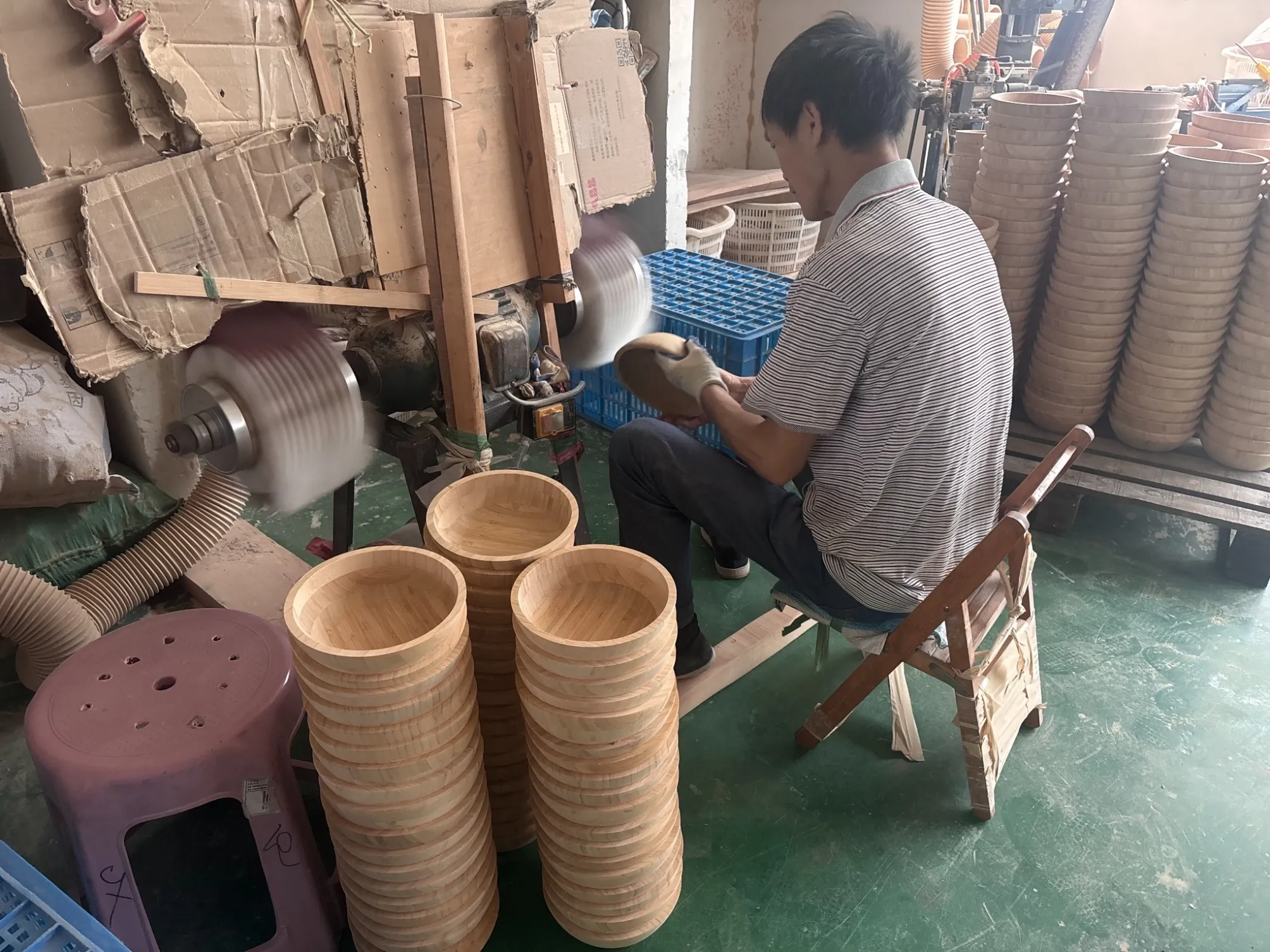
The photographs in this article show real in-process bamboo bowl production, including manual sanding, batch staging and multi-size bowl matching.
They do not show the complete manufacturing process from raw bamboo to finished packaged product. Instead, they document several later production stages that are especially important for bulk-order quality control.
For professional buyers, these stages matter because small variations that may seem minor on one bowl can become much more visible across hundreds or thousands of pieces.
Quick Answer: How Are Bamboo Bowls Produced for Bulk Orders?
A typical bamboo bowl project may involve stages such as:
- Confirming the approved product specification
- Preparing laminated bamboo material
- Forming or machining the bowl body
- Shaping the outer profile
- Controlling the inner bowl curve
- Sanding the rim and outer surfaces
- Refining hand-contact areas
- Grouping bowls by model and size
- Checking dimensional consistency
- Matching sizes for nested sets where required
- Applying the specified surface finish
- Performing final appearance and functional inspection
- Packing according to the approved packaging specification
The photographs in this article focus mainly on sanding, surface preparation, batch consistency and size matching rather than every earlier manufacturing step.
What These Production Photos Show
The visible bowl bodies are made from laminated bamboo construction.
The photographs show:
- Bamboo bowl bodies in several sizes
- Workers carrying out sanding and surface preparation
- Rotating sanding or polishing equipment
- Machine-assisted surface processing
- Large production batches grouped by size
- Unfinished or semi-finished bowl surfaces
- Different bowl profiles
- Multiple bowl sizes that can be checked as a coordinated set
- Products waiting for later production or finishing stages
These photographs should therefore be understood as in-process manufacturing evidence, not as photographs of final retail-ready products.
That distinction is important when evaluating a supplier.
1. Start With a Controlled Bamboo Bowl Specification
Bulk production should begin from one current product specification connected to the approved sample.
For a bamboo bowl project, buyers should confirm details such as:
- Overall diameter or external dimensions
- Bowl height
- Internal depth
- Rim width
- Wall profile
- Bottom thickness
- Base shape
- Bowl profile
- Required size range
- Single-piece or nested-set configuration
- Bamboo construction
- Surface appearance
- Finish requirement
- Logo position and method
- Packaging
- Target market
- Inspection requirements
For nested bowl sets, the specification should define each bowl size separately rather than describing only the largest bowl.
A four-piece set, for example, should have controlled dimensions for all four bowls so that the size progression remains consistent.
Without a clear specification, one production batch may gradually shift away from the approved sample.
2. Bamboo Bowl Construction Must Remain Consistent
The photographs show visible laminated bamboo structure around the bowl walls and base.
This construction creates a distinctive natural appearance, but it also means the buyer should pay attention to more than the overall bowl diameter.
Relevant visual and structural points may include:
- Lamination consistency
- Visible joints
- Open gaps
- Cracks
- Localized glue marks
- Strong color differences
- Surface tear-out
- Edge chipping
- Uneven material transitions
Natural bamboo will not look completely identical from piece to piece.
However, natural variation should be distinguished from manufacturing defects.
A buyer should define an acceptable appearance range rather than expecting every bowl to have exactly the same grain pattern.
3. Bowl Profile Is More Important Than It First Appears
A bowl is a three-dimensional product.
That means several dimensions interact with each other:
- Outside diameter
- Inside diameter
- Wall thickness
- Rim thickness
- Bowl depth
- Inner curve
- Outer curve
- Base width
- Overall height
A bowl can technically meet one diameter measurement while still looking or feeling different from the approved sample because the wall profile or inner curvature has changed.
Professional buyers should therefore evaluate the complete bowl profile, not only one external measurement.
For example, an overly thick rim may make the product feel heavy.
An inconsistent inner curve may affect capacity and appearance.
An unstable base may cause the bowl to rock on a flat surface.
These characteristics should be checked during development before mass production begins.
4. Manual Sanding Helps Refine the Bowl Surface
The cover photograph shows a worker manually handling a bamboo bowl against rotating sanding or polishing equipment.
This stage helps refine areas that require controlled hand contact and visual checking.
Depending on the bowl design, sanding attention may be needed around:
- The upper rim
- Outer side walls
- Bottom edge
- Internal curve
- Transition between rim and wall
- Base
- Areas where machining marks remain visible
The objective is not simply to make the surface “look smooth.”
The finished surface should also feel consistent when the user holds, washes or handles the bowl.
Important defects to watch for include:
- Rough fibers
- Sharp rim areas
- Uneven sanding
- Visible machining lines
- Local depressions
- Scratches
- Burn marks from excessive friction
- Edge chips
Because bowls contain curved surfaces, they often require more careful sanding control than a simple flat bamboo panel.
5. Curved Surfaces Require Different Quality Checks From Flat Products
A cutting board can be checked largely through flatness, edge quality and dimensional control.
A bowl requires additional attention because both the inside and outside surfaces are curved.
The QC team should consider:
Rim Consistency
The rim should appear even around the circumference.
Inner Curve
The inside surface should transition smoothly without obvious machining steps or rough areas.
Outer Profile
The outside shape should remain visually balanced.
Base Stability
The bowl should sit appropriately on a flat surface according to the approved design.
Wall Consistency
The wall should not appear dramatically thicker on one side than another.
Surface Feel
Areas touched by the user should be free from obvious roughness or sharp fibers.
This is why one quick measurement cannot represent the complete quality of a bowl.
6. Batch Production Makes Consistency More Visible
When only one sample is placed on a table, small dimensional or color variations may not be obvious.
Once dozens or hundreds of bowls are grouped together, differences become easier to see.
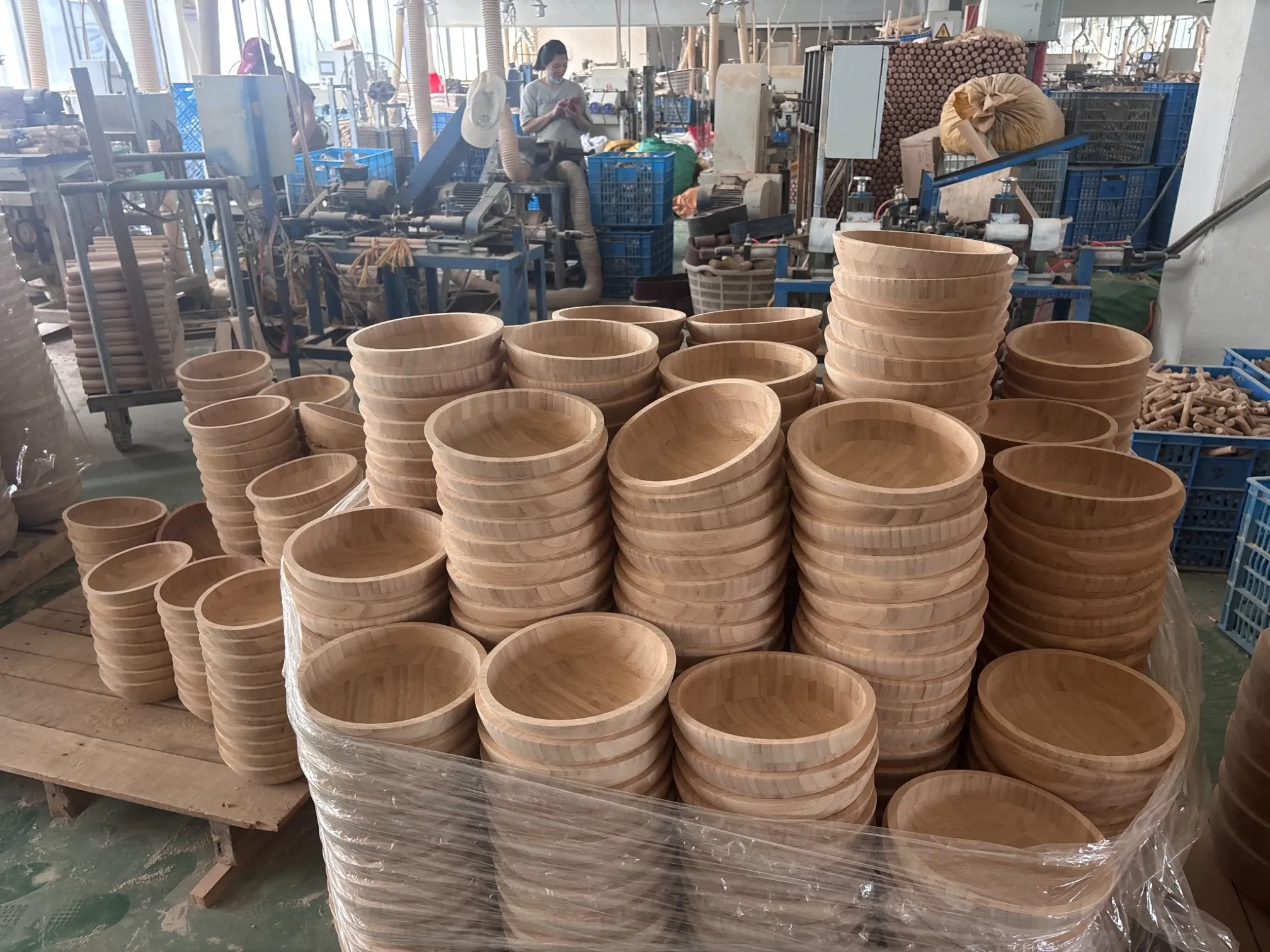
Multiple bamboo bowl sizes grouped during production for batch control and further processing.
The production photograph shows multiple sizes and large quantities of bowl bodies staged together.
At this stage, practical batch-control checks may include:
- Correct size group
- Correct bowl model
- Consistent profile
- Rim appearance
- Visible cracks
- Surface condition
- Obvious dimensional outliers
- Mixed-size prevention
- Production status
Grouping products clearly is especially important when several bowl sizes are being produced at the same time.
Without adequate identification, a bowl intended for one set size may accidentally be mixed into another batch.
7. Multiple Sizes Need Separate Control
The photographs show bowls in different dimensions rather than only one single size.
For a multi-size program, buyers should not assume that scaling the diameter automatically creates a correct product family.
Each size may require independent control of:
- Diameter
- Height
- Wall thickness
- Internal depth
- Rim proportion
- Base proportion
- Weight
- Nesting relationship
The visual proportions should also remain coherent across the collection.
For example, if the smallest bowl has a very thick-looking rim while the largest bowl has a much thinner profile, the set may look inconsistent even if each bowl is individually functional.
This becomes especially important for retail sets where multiple bowls are presented together.
8. Nested Bowl Sets Require Size-Matching Control
The fourth production photograph shows several bamboo bowls placed inside one another as a nested multi-size set.
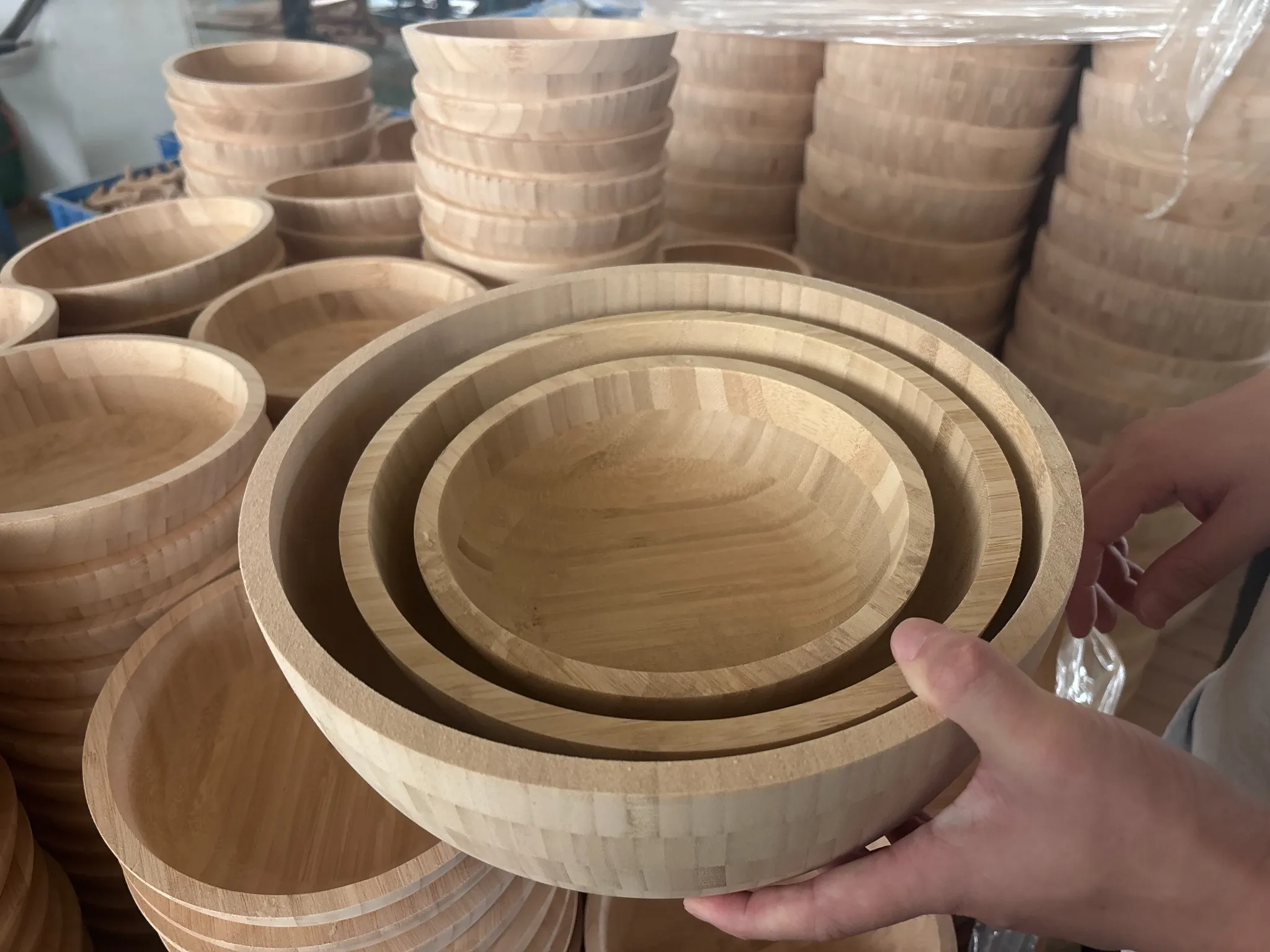
A multi-size bamboo bowl set checked for nesting sequence, proportional sizing and fit.
For this type of product, buyers should evaluate more than the dimensions of individual pieces.
Important set-level questions include:
- Do the bowls nest in the correct sequence?
- Is there sufficient clearance between sizes?
- Can each bowl be removed easily?
- Are the size differences visually balanced?
- Does one bowl sit too deeply inside another?
- Do the rims interfere?
- Does the complete set remain stable when nested?
- Is the total nested height suitable for packaging?
If the clearance is too small, bowls may become difficult to separate.
If the clearance is too large, the set may look poorly coordinated or require unnecessarily large packaging.
A nested set therefore needs to be evaluated as one complete product system, not simply as several unrelated bowls.
9. Rim Quality Is a Critical Hand-Contact Area
The upper rim is one of the first areas a buyer or end customer will touch.
It is also highly visible.
Buyers should inspect:
- Rim smoothness
- Uniform shape
- Consistent thickness
- Chips
- Splinters or raised fibers
- Rough sanding marks
- Local dents
- Open bamboo joints
- Surface finish around the edge
A well-finished rim contributes significantly to perceived product quality.
Even if the main bowl body looks attractive, a rough or inconsistent rim can immediately make the product feel unfinished.
For this reason, rim inspection should be treated as a critical appearance and hand-feel checkpoint.
10. The Inner Surface Needs Its Own Inspection
The inside of the bowl is not automatically acceptable simply because the outside looks smooth.
The internal surface should also be evaluated for:
- Rough areas
- Visible sanding marks
- Uneven curvature
- Surface scratches
- Glue residue
- Cracks
- Localized discoloration
- Edge transitions
- Cleanliness before finishing
Deep curved areas can be more difficult to inspect than flat products.
Lighting and hand-feel checks can therefore be useful during surface inspection.
11. Surface Sanding Should Be Completed Before Final Finish Approval
The bowls visible in these production photographs appear to be in an unfinished or semi-finished production condition.
The final surface treatment is not established by these photographs alone.
Depending on the project, the buyer should separately confirm:
- Required surface finish
- Target color
- Gloss or matte appearance
- Coating or oil specification where applicable
- Intended use
- Care instructions
- Target-market requirements
The finished product should then be checked after the specified surface treatment has been applied.
This matters because surface finishing can change:
- Color
- Grain contrast
- Hand feel
- Apparent sanding quality
- Fit between nested pieces
- Final appearance
A product should therefore not receive final appearance approval solely at the unfinished sanding stage.
12. Natural Bamboo Color Variation Should Be Defined Before Bulk Production
Bamboo is a natural material.
Variation can appear in:
- Tone
- Grain
- Laminated strip appearance
- Node visibility
- Light and dark areas
- Joint pattern
Professional buyers should agree on an acceptable appearance range.
The objective should not be to force every bowl to look artificially identical.
Instead, QC should identify pieces that fall clearly outside the approved visual standard.
For a multi-piece bowl set, appearance matching may deserve additional attention because several pieces are viewed together.
If one bowl is dramatically darker or visually different from the other bowls in the same retail set, customers may perceive the set as inconsistent.
13. Sample-to-Bulk Consistency Matters More Than One Good Sample
A high-quality development sample does not automatically guarantee a consistent mass-production order.
Before bulk production, the project should ideally have a controlled reference including:
- Approved sample
- Confirmed dimensions
- Bowl profile
- Bamboo construction
- Surface standard
- Size sequence
- Nested-set requirements where applicable
- Logo
- Packaging
- Inspection criteria
When revisions are made during sampling, the final approved version should be clearly identified.
Production and QC teams need to know which version represents the actual order.
This is particularly important for bowl sets because a change to one size may affect nesting, packaging and overall set appearance.
For a broader supplier-qualification checklist, buyers can also review our bamboo and wood houseware manufacturer evaluation guide.
14. Packaging Should Protect the Rim and Surface
Bamboo bowls have different packaging risks from flat products.
Potential transport issues may include:
- Rim impact
- Surface rubbing
- Bowls moving inside the package
- Nested bowls becoming difficult to separate
- Scratches between pieces
- Carton compression
- Edge damage
Depending on the product configuration, packaging may need to consider:
- Individual protection
- Paper or suitable separators
- Nested-set protection
- Retail box dimensions
- Internal movement
- Export-carton strength
- Product orientation
- Carton quantity
Packaging should be confirmed using the finished product dimensions, not only preliminary bowl blanks.
For nested sets, the final packed height and overall set dimensions should also be measured before retail packaging is finalized.
Bamboo Bowl Quality-Control Checklist for B2B Buyers
QC Area | What Buyers Should Confirm |
|---|---|
Material | Confirmed bamboo construction and approved appearance |
Dimensions | Diameter, height, depth and base dimensions |
Bowl Profile | Inner and outer curves match the approved sample |
Rim | Smooth, even and free from chips or raised fibers |
Wall | Consistent visual thickness and no obvious deformation |
Base | Stable according to the approved design |
Sanding | No obvious rough areas, deep scratches or machining marks |
Surface | Approved appearance after final finishing |
Batch Control | Correct model and size separated during production |
Nested Set | Correct sequence, clearance, fit and overall set proportion |
Branding | Correct logo method, position and appearance |
Packaging | Appropriate protection for rims, surfaces and nested pieces |
Common Bamboo Bowl Production Risks
Potential Issue | Possible Cause | Recommended Control |
|---|---|---|
Rough rim | Incomplete sanding | Add rim-focused hand-feel inspection |
Uneven bowl profile | Machining or shaping variation | Compare against approved dimensions and reference sample |
Bowl rocks on table | Base inconsistency | Check completed bowls on a flat surface |
Visible sanding marks | Insufficient surface preparation | Inspect under suitable lighting before finishing |
Strong color mismatch | Natural variation without sorting standard | Agree on acceptable appearance range |
Mixed bowl sizes | Weak batch identification | Separate and label production groups clearly |
Nested bowls stick | Insufficient size clearance | Check full nesting and removal before approval |
Nested set looks uneven | Poor size progression | Approve dimensions and proportions for the complete set |
Surface scratches | Handling between production stages | Improve staging and product separation |
Rim damage during transport | Inadequate packaging protection | Confirm retail and export packaging before shipment |
15. What These Factory Photos Can—and Cannot—Prove
Real production photographs are useful because they show physical manufacturing activity.
These photographs can support the presence of:
- Bamboo bowl production
- Manual sanding
- Production equipment
- Multiple bowl sizes
- Batch quantities
- In-process handling
- Nested size matching
However, the photographs alone do not prove:
- Exact product dimensions
- Final coating or finish
- Exact order quantity
- Customer identity
- Product testing results
- Food-contact compliance
- Certification scope
- Final inspection results
Those points require separate specifications, records or project documentation.
For professional buyers, supplier evaluation should combine real factory evidence with approved specifications, samples, packaging information and quality-control requirements.
How Rewood Supports Custom Bamboo Bowl Projects
Rewood supports importers, distributors, retailers and private-label homeware brands with bamboo and wooden houseware development and bulk production.
Depending on the individual bamboo bowl project, support may include:
- Product-size development
- Bowl-profile evaluation
- Multi-size set development
- Nested-set configuration
- Sample development
- OEM/ODM customization
- Logo application
- Private-label packaging
- Barcode and label coordination
- Production follow-up
- Quality-control coordination
- Export-carton preparation
- Shipment preparation
The final material, size, construction, finish, MOQ, packaging and inspection requirements are confirmed according to the actual project.
Buyers developing a customized project can also review our guide to requesting a quote for custom bamboo and wood houseware before sending an RFQ.
What Information Is Needed for a Bamboo Bowl Quotation?
For an initial evaluation, please send:
- Reference photo or drawing
- Bowl shape
- Required dimensions
- Number of sizes
- Single bowl or set configuration
- Estimated quantity
- Surface-finish requirement
- Logo requirement
- Packaging preference
- Target market
- Delivery destination
- Required timeline
For a nested bowl set, please also confirm whether you already have target dimensions for each bowl or whether you need support developing the size progression.
Frequently Asked Questions
How Are Bamboo Bowls Made for Bulk Orders?
A typical bamboo bowl project involves controlled bamboo material preparation, forming or machining, profile shaping, sanding, surface preparation, finishing, quality inspection and packaging. The exact process depends on the bowl design and approved specification.
Are the Bowls in These Photos Finished Products?
No. The photographs show in-process bowl production, including sanding, batch handling and size matching. The final surface finish and retail packaging are separate project stages.
What Should Buyers Check During Bamboo Bowl Production?
Key points include bowl diameter, depth, rim quality, wall profile, base stability, sanding, surface appearance, bamboo variation, size consistency and packaging protection.
Can Bamboo Bowls Be Produced in Different Sizes?
Yes. Different size programs can be evaluated according to the project. Each size should have its own controlled dimensions and profile.
Can Several Bamboo Bowls Be Developed as a Nested Set?
Yes. A multi-size nested set can be evaluated, but the size progression and clearance between bowls should be confirmed during sampling so that the pieces nest and separate correctly.
Can the Shape of a Bamboo Bowl Be Customized?
Different bowl profiles can be evaluated according to the design, dimensions, construction and production feasibility. A reference photo, drawing or sample is helpful for initial review.
Can a Custom Logo Be Added?
Logo options can be evaluated according to the bowl design, requested branding method and surface requirements.
Can Private-Label Packaging Be Developed?
Yes. Packaging can be developed according to the product configuration, quantity, sales channel and target market. Nested sets may require different protection from individual bowls.
Are Bamboo Bowls Automatically Food-Contact Compliant?
No universal compliance claim should be assumed. Testing and documentation requirements should be confirmed according to the actual product, material, surface finish, manufacturing entity and target market.
Does Natural Bamboo Color Vary?
Yes. Natural bamboo may show differences in tone, grain and laminated appearance. Buyers and suppliers should agree on an acceptable visual range for bulk production.
Discuss Your Bamboo Bowl Project with Rewood
A bamboo bowl may look simple, but consistent bulk production depends on controlling the complete product—not only the outer diameter.
Bowl profile, rim quality, sanding, surface appearance, size progression, nested-set fit and packaging all influence the final result.
Send Rewood your reference image, dimensions, required sizes, target quantity, branding requirements, packaging preference and destination market.
About the Author
Written by Jessie Jiang
Overseas Business Development, Rewood Houseware
Jessie works with importers, distributors, retailers and private-label brands on bamboo and wood houseware manufacturing, OEM/ODM product development, sampling, custom packaging, quality control and export projects.
Reviewed by the Rewood Product Development & Quality Control Team
This article is based on real bamboo bowl production photographs and Rewood’s practical experience supporting bamboo and wooden houseware development, bulk production and quality-control projects.
Last updated: August 27, 2026